A Common Mistake Many Buyers Make
One of the most common assumptions in international sourcing sounds perfectly logical:
“If I buy directly from the factory, I’ll get the lowest price.”
Sometimes that’s true.
Sometimes it’s completely wrong.
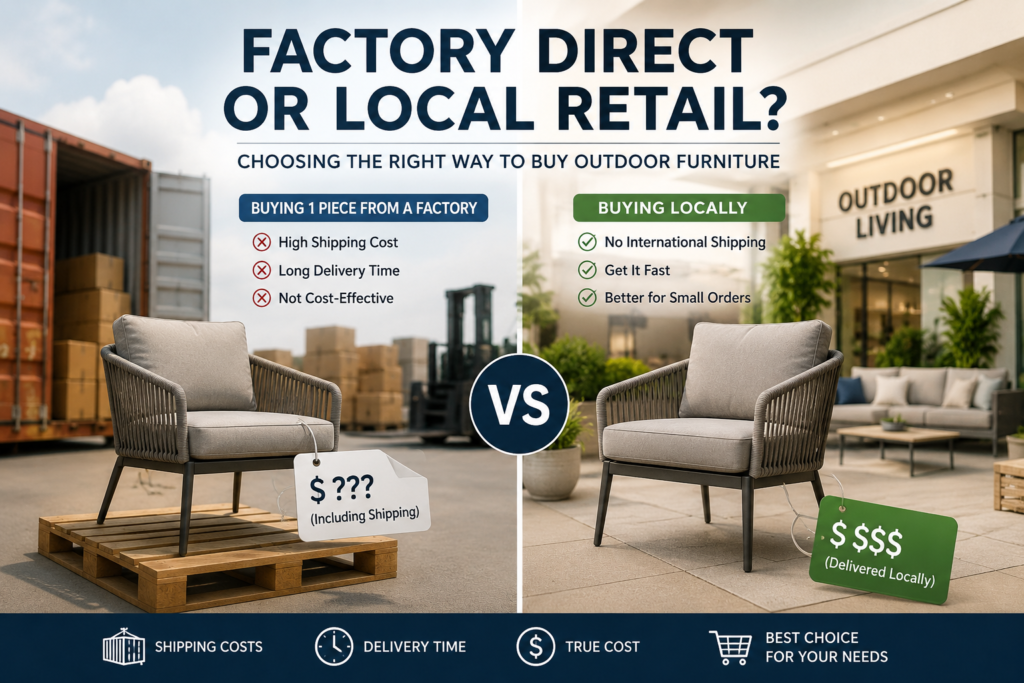
Every month, we receive inquiries from homeowners looking for a single chair, a dining table, or one outdoor sofa set for their backyard.
The request itself isn’t unusual.
What surprises many buyers is when they discover that ordering one piece directly from a factory in China can actually cost more than buying a similar product from a local retailer.
At first glance, that doesn’t seem to make sense.
After all, aren’t factories supposed to be cheaper?
The answer depends on what you’re buying—and more importantly, how much you’re buying.
The Factory Is Not a Retail Store
Many buyers unknowingly compare two completely different business models.
A retailer exists to sell products individually.
A factory exists to manufacture products efficiently.
Those may sound similar, but they’re not.
When you visit Costco, Home Depot, Wayfair, or a local furniture store, the products are already sitting in a warehouse somewhere in your country.
The retailer has already purchased thousands of units, imported them, stored them, and distributed the logistics costs across many customers.
Everything is optimized for individual purchases.
Factories work differently.
Most factories are designed around production runs rather than individual sales.
Their systems, purchasing plans, labor schedules, packaging methods, and shipping arrangements are all built for larger quantities.
That’s why the economics can look very different when someone wants only one piece.
The Question We Often Receive
A conversation often starts like this:
“How much for one chair?”
On the surface, it seems like a simple question.
But from a manufacturing perspective, producing one chair still requires many of the same processes used for larger orders.
Materials still need to be sourced.
Production still needs to be scheduled.
Quality inspections still need to happen.
Packaging still needs to be prepared.
Documentation still needs to be completed.
Whether a factory produces one chair or fifty chairs, much of the preparation work remains surprisingly similar.
The difference is that with larger orders, those costs are spread across more products.
With a single chair, they are not.
The Freight Cost Nobody Expects
In our experience, shipping is usually the biggest surprise.
Many buyers focus on product cost because that’s what they’re used to seeing online.
But furniture isn’t like electronics or clothing.
Furniture takes up space.
A lot of space.
A single outdoor chair might not weigh very much, but it still requires a large carton.
A sofa may be lightweight aluminum, yet still occupy significant volume during transportation.
International freight companies often charge based on space rather than weight.
As a result, the shipping cost for a single chair can sometimes feel unreasonable compared to the product itself.
We’ve seen buyers become frustrated because they believed factory pricing would automatically be lower than local retail pricing.
In reality, the product cost may indeed be lower—but once international shipping is added, the final cost tells a different story.
Why Costco Can Sometimes Beat the Factory
This is one of the most misunderstood aspects of global sourcing.
Many people assume:
Factory = Cheapest
But that’s not always true.
Large retailers have advantages that individual buyers don’t.
They purchase entire containers.
They negotiate long-term shipping contracts.
They operate regional warehouses.
They spread transportation costs across thousands of orders.
By the time a customer purchases one patio set locally, most of the logistics cost has already been absorbed into a highly optimized distribution system.
The customer benefits from economies of scale without even realizing it.
This is one reason why buying a single outdoor furniture set from a local retailer is often the smarter financial decision.
The Real Issue Isn’t Price
The real issue is usually choosing the right purchasing channel.
Imagine someone needs one outdoor dining set for their backyard and wants it delivered next week.
A local retailer is probably the perfect solution.
Now imagine a hotel project requiring fifty dining sets, thirty lounge chairs, and multiple custom sofas.
Suddenly, the economics change dramatically.
The more furniture involved, the more manufacturing efficiency matters.
The more customization required, the more valuable direct factory cooperation becomes.
This is why factories and retailers serve different types of customers.
Neither approach is wrong.
They’re simply designed for different situations.
When Buying Directly from a Factory Makes Sense
Factory sourcing becomes far more attractive when projects involve customization or volume.
For example, many of our customers are:
- Hotels
- Resorts
- Restaurants
- Property developers
- Architects
- Interior designers
- Landscape designers
These projects often require furniture that cannot be purchased directly from a retail shelf.
Perhaps the dimensions need adjustment.
Perhaps the cushions must match a specific color palette.
Perhaps the project requires materials suitable for coastal environments.
Perhaps hundreds of pieces need to be manufactured consistently.
This is where factories provide significant value.
The goal is no longer simply purchasing furniture.
The goal is creating a solution.
Customization Changes Everything
One reason many commercial buyers work directly with factories is because customization is often impossible through traditional retail channels.
A designer may need:
- A sofa length that doesn’t exist in standard collections.
- A custom fabric color.
- A special rope weave.
- A unique teak finish.
- Project-specific branding.
These requirements typically cannot be solved by ordering from a warehouse.
Instead, they require collaboration with a manufacturer.
This is where factories excel.
Not because they’re necessarily cheaper.
But because they can create exactly what the project needs.
Sometimes We Recommend Buying Locally
This may sound strange coming from a manufacturer, but it’s true.
There are situations where we genuinely recommend that customers purchase locally instead of importing from China.
If someone needs:
- One chair
- One coffee table
- One sofa set
- Fast delivery
- No customization
A local retailer is often the better choice.
The customer saves time.
The customer avoids international freight.
The customer receives the product faster.
Most importantly, the purchasing channel matches the actual requirement.
A good supplier should help customers make the right decision—even when that decision doesn’t result in a sale.
Factory Pricing Is Designed for Projects
Factories thrive when projects require:
- Multiple units
- Customization
- Commercial durability
- Design flexibility
- Consistent production quality
These are the situations where direct manufacturing relationships create value.
The larger and more specialized the project becomes, the greater the advantages of working directly with a factory.
For a single patio chair, those advantages may never be realized.
For a resort development, they become significant.
Final Thoughts
Buying directly from a factory isn’t automatically better.
Just as buying locally isn’t automatically cheaper.
The best purchasing decision depends on the project itself.
If you need one outdoor chair for your backyard next week, your local retailer may be the smartest solution.
If you’re furnishing a hotel, developing a residential community, or creating a custom outdoor living project, direct factory sourcing can provide flexibility, customization, and long-term value that retail channels simply cannot offer.
The key is understanding that factories and retailers serve different purposes.
When the purchasing channel matches the project, everyone wins.