Why Customers Don’t Actually Want Cheap Products—They Want Value
If you’ve worked in manufacturing long enough, you’ve probably heard the same question countless times:
“Can you do a better price?”
There’s nothing wrong with that question.
Price matters.
Every buyer has a budget. Every project has financial constraints. Every company wants to maximize its investment.
But over the years, we’ve noticed something interesting.
The customers who focus only on price are rarely the most successful customers.
And the companies that compete only on price rarely become the strongest brands.
Because despite what many people say, most customers aren’t actually looking for the cheapest product.
They’re looking for the best value.
Those two things are not the same.
Nobody Wakes Up Hoping to Buy Something Cheap
Think about the products you use every day.
Your phone.
Your car.
Your office chair.
Your favorite pair of shoes.
When you bought them, was your goal to find the cheapest option available?
Probably not.
What you really wanted was something that worked.
Something reliable.
Something that wouldn’t create problems six months later.
Most people don’t enjoy spending money. But they enjoy wasting money even less.
That’s why customers are often willing to pay more when they believe they’re receiving greater value in return.
The problem is that value is harder to see than price.
Price is a number.
Value is an experience.
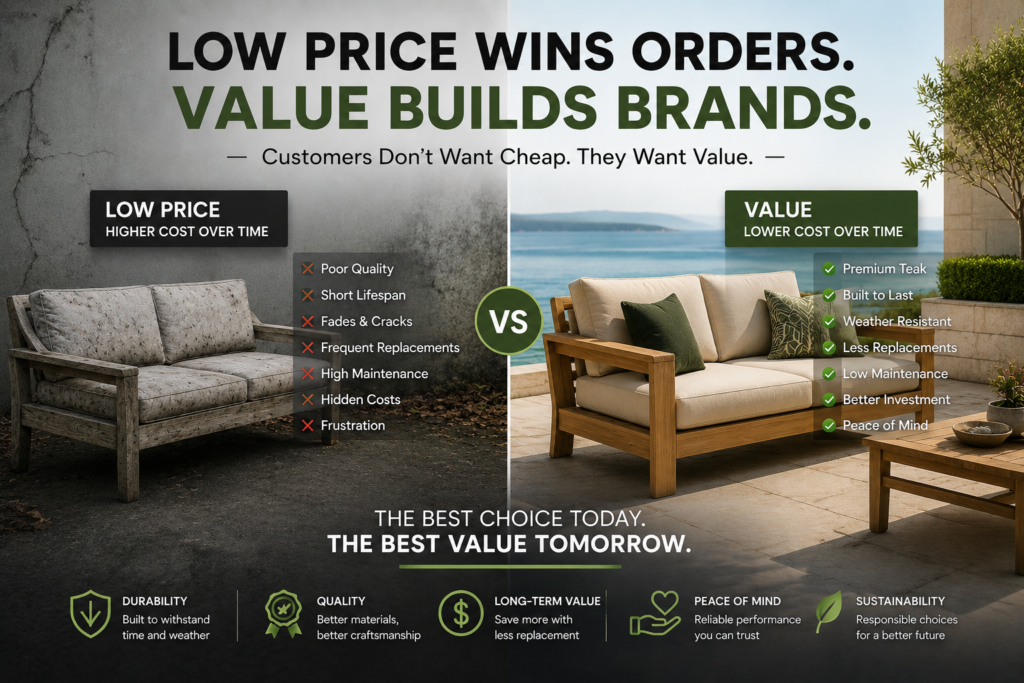
Cheap Products Often Become Expensive
In the outdoor furniture industry, we’ve seen this happen many times.
A buyer compares two products.
One costs significantly less.
The specifications look similar.
The photos look similar.
The dimensions are almost identical.
So the cheaper option seems like the obvious choice.
A year later, the situation can look very different.
The cushions lose their shape.
The fabric starts fading.
The frame develops corrosion.
Replacement parts become impossible to find.
Now the buyer isn’t simply paying for furniture anymore.
They’re paying for repairs, replacements, additional shipping, labor, and frustration.
The original purchase may have been cheaper.
The total cost was not.
The Parts You Can’t See Usually Matter Most
One of the challenges in manufacturing is that many quality differences are invisible at first glance.
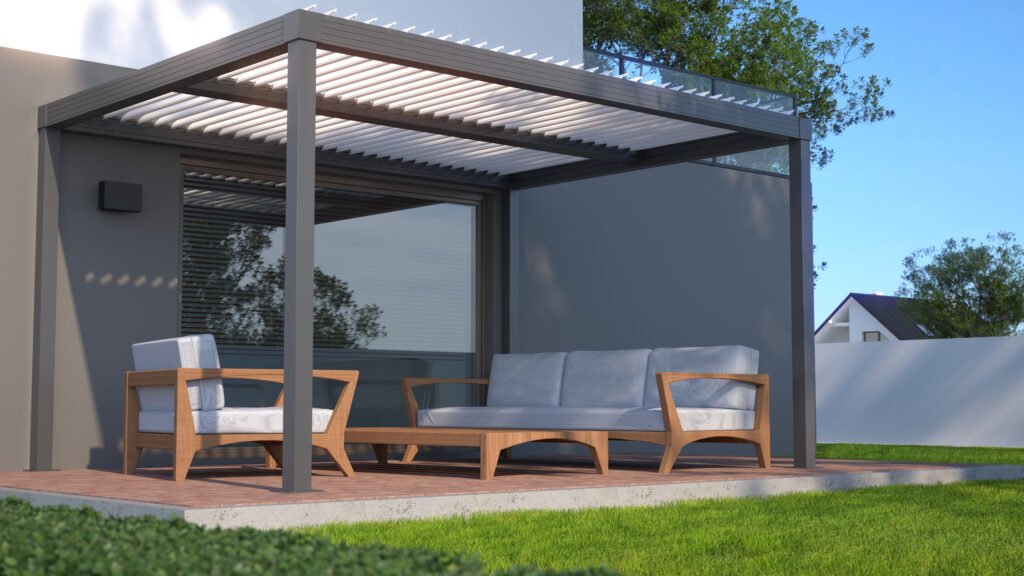
Two outdoor sofas can look nearly identical in a photograph.
Yet one may last three times longer than the other.
Why?
Because quality is often hidden beneath the surface.
It might be a stronger aluminum frame.
A better welding process.
Higher-quality powder coating.
Quick-dry foam instead of conventional foam.
Premium outdoor fabrics rather than low-cost alternatives.
Most customers never see these details during the buying process.
They only notice them later, when one product continues performing while the other begins to fail.
That’s why evaluating furniture based solely on appearance—or price—can be misleading.
Every Low Price Comes From Somewhere
This is a reality many buyers never consider.
Products don’t become cheaper by magic.
When a manufacturer significantly lowers a price, something usually changes behind the scenes.
Sometimes it’s material quality.
Sometimes it’s labor.
Sometimes it’s quality control.
Sometimes it’s packaging.
Sometimes it’s after-sales support.
The challenge is that these compromises aren’t always visible on a quotation sheet.
The number looks attractive.
The consequences arrive later.
This doesn’t mean every low-cost product is bad.
Nor does it mean every expensive product is good.
But it does mean buyers should understand what they’re comparing before making decisions.
Strong Brands Rarely Compete on Price Alone
Take a look at some of the world’s most respected brands.
Apple isn’t the cheapest smartphone manufacturer.
Patagonia isn’t the cheapest outdoor apparel company.
Herman Miller isn’t the cheapest office furniture brand.
Sunbrella isn’t the cheapest outdoor fabric.
Yet customers continue choosing them.
Why?
Because these companies compete on something bigger than price.
They compete on trust.
Design.
Performance.
Consistency.
Reputation.
Customers know what they’re getting.
That confidence has value.
And value is often what creates long-term brand loyalty.
The Best Buyers Ask Different Questions
One of the most noticeable differences between experienced buyers and inexperienced buyers is the questions they ask.
New buyers often ask:
“Why is this more expensive?”
Experienced buyers often ask:
“Why is this better?”
It’s a subtle difference, but it changes everything.
The first question focuses on cost.
The second focuses on value.
Hotel developers, designers, procurement managers, and hospitality operators understand this well.
They’re not simply purchasing products.
They’re making decisions that affect guest experiences, maintenance budgets, and long-term project performance.
A product that saves a few hundred dollars today but creates thousands of dollars in problems later is not a good investment.
Reliability Has a Value That Doesn’t Appear on a Quote
One of the most underrated aspects of any purchase is reliability.
A reliable supplier delivers when promised.
A reliable product performs as expected.
A reliable manufacturer answers the phone when problems occur.
None of those things appear as a separate line item on a quotation.
Yet they often become incredibly important once a project begins.
The same principle applies to products themselves.
Furniture that survives years of sun, rain, and daily use creates value long after the purchase order has been signed.
That value may be difficult to measure upfront.
But it’s impossible to ignore over time.
What Customers Really Want
After years of working with homeowners, designers, hotels, and developers, we’ve learned something simple.
Most customers aren’t actually searching for the lowest price.
They’re searching for peace of mind.
They want products that work.
They want suppliers they can trust.
They want projects that run smoothly.
They want furniture that looks good years from now, not just on delivery day.
In other words, they’re looking for value.
Price is part of that equation.
But it’s rarely the entire equation.
The Difference Between Winning an Order and Building a Brand
A low price can win an order.
Sometimes it does.
But building a respected brand requires something more sustainable.
Brands earn loyalty when they consistently deliver value.
They solve problems.
They stand behind their products.
They create positive experiences.
Over time, customers remember those things far longer than they remember the original price.
That’s why some brands survive for decades while others disappear after a few years.
One competes on cost.
The other competes on value.
Final Thoughts
In today’s market, price is visible everywhere.
Value is harder to measure.
That’s why many buying decisions start with cost comparisons.
But the most successful purchasing decisions rarely end there.
The furniture industry—and virtually every other industry—offers countless examples of products that were cheap to buy but expensive to own.
The opposite is often true as well.
Products that cost more upfront frequently deliver greater value over their lifetime.
So when evaluating suppliers, products, or brands, it may be worth asking a different question.
Not:
“Which option is the cheapest?”
But:
“Which option creates the most value?”
Because low price may win attention.
But value is what earns trust.
And trust is what builds brands that last.