
Quick Answer
How should retailers plan fireplace inventory for winter?
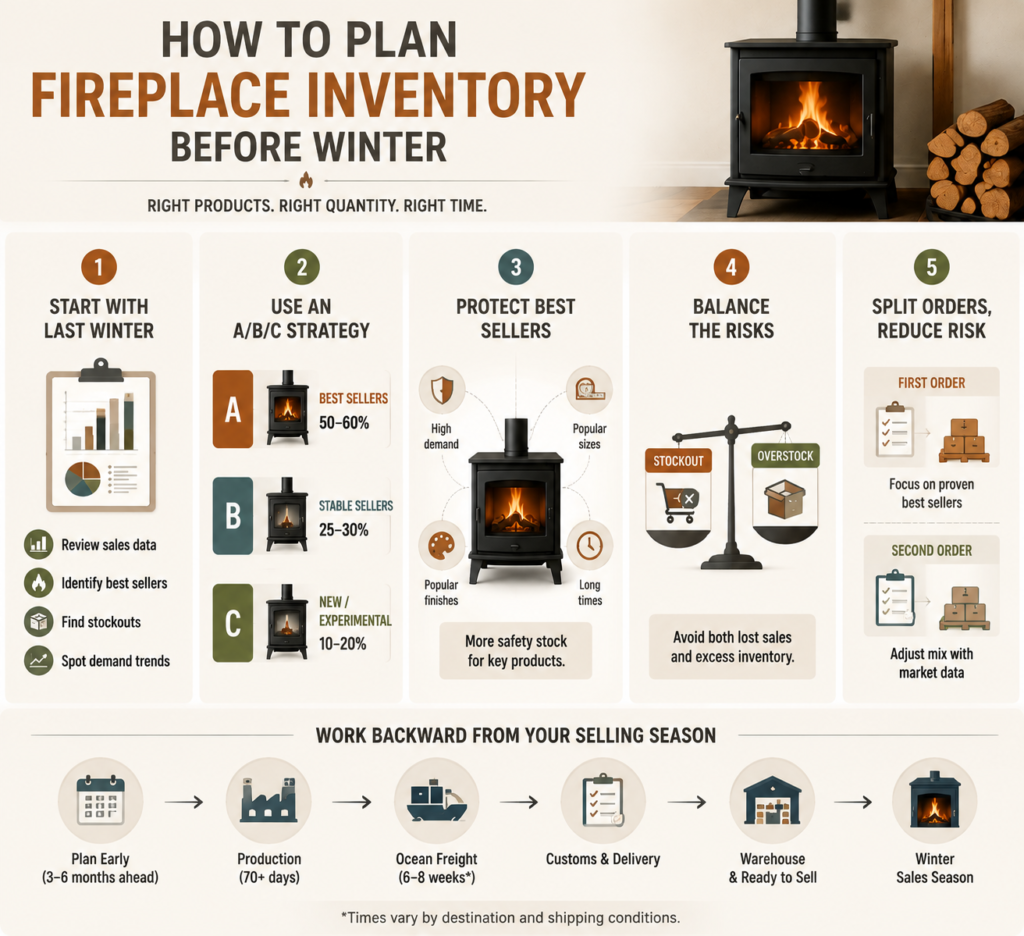
Effective fireplace inventory planning starts with last season’s sales data, not guesswork. Buyers should prioritize proven best sellers, keep reasonable safety stock for high-demand models, limit quantities of untested products, and work backward from the winter selling season to account for production and shipping. For imported fireplaces, planning 3–6 months ahead gives buyers more flexibility to balance the two biggest seasonal inventory risks: running out too early and ordering more than the market can absorb.
Ordering Early Solves One Problem—but Creates Another Question
For seasonal products like indoor fireplaces and wood-burning stoves, waiting until winter to place an order is usually too late.
Production takes time.
International transportation takes time.
Customs clearance and warehouse receiving take time.
And during the peak ordering season, factory lead times can become significantly longer.
That’s why experienced fireplace buyers begin planning months before temperatures start to fall.
But once you decide to order early, another question immediately appears:
How much should you order?
Order too little, and your best-selling models may disappear from stock just as demand peaks.
Order too much, and valuable cash becomes tied up in inventory that may sit in your warehouse until the following season.
The goal of good inventory planning isn’t simply to buy more.
It’s to have the right fireplaces, in the right quantities, available at the right time.
Start With Last Winter, Not This Winter
The best forecast for the coming winter often begins with what happened during the previous one.
Before placing a new order, review your sales history.
Ask:
- Which fireplace models sold fastest?
- Which models sold out first?
- Which sizes generated the most consistent demand?
- Which finishes or colors performed best?
- Which models remained in stock after winter?
- When did demand begin increasing?
- When did sales begin slowing down?
These questions reveal much more than total annual sales.
For example, imagine you sold 200 fireplaces last season.
That number alone isn’t particularly useful.
Perhaps 100 units came from only two models, while ten other models accounted for the remaining 100.
If you reorder every model equally, you may create excess inventory in slow-moving products while running out of the fireplaces customers actually want.
Inventory planning should follow demand—not assortment size.
Don’t Treat Every Fireplace Equally
One of the simplest ways to improve fireplace inventory planning is to divide products into groups according to their sales performance.
A practical approach is an A/B/C inventory strategy.
| Category | Role | Suggested Inventory Focus |
| A | Proven best sellers | Highest stock priority |
| B | Stable sellers | Moderate inventory |
| C | New or experimental models | Controlled quantities |
A: Your Best Sellers
These are the fireplaces customers already understand and consistently purchase.
They might represent only a small percentage of your product range while generating a large share of your winter revenue.
These models deserve the strongest inventory protection.
Depending on your sales history, they might represent roughly 50–60% of your seasonal purchasing budget or volume.
B: Reliable Supporting Models
These products sell consistently but don’t move as quickly as your leading models.
They provide customers with additional choices in size, design, finish, or price.
A reasonable starting point might be approximately 25–30% of planned inventory, adjusted according to your own sales data.
C: New and Experimental Products
Every retailer needs new products.
But new products come with uncertainty.
Instead of committing large quantities before understanding market response, introduce them in smaller batches.
Perhaps 10–20% of the inventory plan can be allocated to new or less predictable products.
These percentages aren’t universal rules. They’re simply a framework.
Your actual allocation should always follow your own market, customers, and historical sales performance.

Protect Your Best Sellers With Safety Stock
Imagine your most popular wood-burning stove sells steadily throughout November and December.
Then, just before the coldest part of winter, inventory reaches zero.
Demand still exists.
Customers are still searching.
Your marketing is still generating traffic.
But there’s nothing available to sell.
This is exactly where safety stock becomes valuable.
Safety stock is additional inventory held to protect against unexpected demand or supply delays.
But it doesn’t need to be distributed equally across every product.
Your strongest safety stock should usually protect:
- Proven best sellers
- Standard sizes
- Popular finishes
- Products with consistent historical demand
- Models that are difficult to replenish quickly
Slow-moving products may require little or no additional buffer.
The objective isn’t to fill the warehouse.
It’s to protect the products most likely to generate sales when replacement inventory can’t arrive quickly enough.
Understand the Difference Between Overstock and Stockout
Buyers naturally worry about overstock.
And they should.
Excess inventory consumes warehouse space, ties up working capital, and can create pressure to discount products later.
But there is another cost that receives less attention:
The cost of running out.
Imagine a retailer sells 50 units of a popular fireplace each month at an average retail price of $800.
If that product remains unavailable for one month during peak season, up to:
50 × $800 = $40,000
in potential product revenue may be unavailable during that period.
That doesn’t mean every dollar would necessarily have converted into a sale. But it illustrates why stockouts deserve to be treated as a commercial risk rather than simply an inventory inconvenience.
And the potential impact doesn’t stop there.
A customer searches for a fireplace.
Your best seller appears.
They click.
Out of Stock.
They search again.
A competitor has a comparable fireplace available immediately.
The customer buys there instead.
For seasonal products, availability itself becomes part of the product’s value.
Seasonal Products Have a Limited Selling Window
A fireplace isn’t necessarily obsolete when winter ends.
But its strongest selling opportunity may be.
That’s what makes seasonal inventory different.
If a sofa arrives one month later than planned, it can still sell throughout the year.
If a large fireplace shipment arrives after the coldest months have passed, the buyer may need to carry that inventory until the next heating season.
That’s why fireplace inventory planning should focus on the selling window, not simply the delivery date.
Ask:
When do my customers normally start buying?
Then work backward.
Inventory should ideally be received, checked, entered into your system, distributed to dealers, and ready for sale before that demand curve reaches its peak.
Remember the Full Replenishment Cycle
This becomes particularly important when purchasing fireplaces internationally.
A buyer may see a factory lead time and assume that’s the amount of time required to replenish stock.
It isn’t.
The real replenishment cycle looks more like this:
Purchase Order
→
Production
→
Inspection & Packing
→
Container Loading
→
Ocean Freight
→
Customs Clearance
→
Inland Delivery
→
Warehouse Receiving
→
Available Inventory
During the August–September fireplace ordering peak, CG Outdoor’s current production cycle can extend beyond 70 days.
International ocean transportation may add another several weeks depending on destination and shipping conditions.
This means a buyer who notices low inventory in December may not be able to replenish that product while the strongest winter demand still exists.
That reality should influence how much safety stock you hold before the season begins.
Consider Splitting Seasonal Orders
Planning ahead doesn’t necessarily mean placing one enormous order and hoping the forecast is correct.
For some buyers, a staged purchasing strategy may offer greater flexibility.
Suppose your forecast suggests you may need approximately 300 fireplaces.
Instead of treating all 300 units identically, you could structure purchasing around confidence levels.
For example:
First production order
Focus on proven A-category products and the quantities you’re highly confident you can sell.
Later production allocation
Use early market signals to adjust the mix of secondary models where production capacity and shipping schedules still allow it.
This approach can reduce some forecasting risk.
However, timing matters.
A second order placed too late may still arrive after peak demand, especially when production schedules are already full.
Split ordering works best when it’s planned before the season, not used as an emergency reaction after inventory has already run out.
New Models Should Earn Their Inventory
New fireplace designs are important for keeping a collection fresh.
But a new model has no sales history.
That makes it inherently more difficult to forecast.
Instead of treating a new fireplace like an established bestseller, consider using the first season to gather information.
Order a controlled quantity.
Track inquiries.
Measure conversion.
Listen to dealer feedback.
Watch which sizes and finishes customers prefer.
Then use that information when planning the following season.
A successful new model can gradually move from Category C to Category B—and eventually become one of your Category A products.
Inventory should grow with evidence.
Don’t Forget Certification, Packaging, and Private Labeling
Inventory planning isn’t only about quantity.
Some fireplace orders require additional preparation before production can begin.
Depending on the product and destination market, buyers may need to confirm:
- Certification requirements
- Product labels
- Instruction manuals
- Packaging design
- Carton markings
- Private branding
- Accessories
- Spare parts
- Inspection requirements
These decisions take time.
Waiting until the factory is ready to start production before discussing them can create unnecessary delays.
For private-label and distributor programs especially, specifications should ideally be finalized well before the planned production window.
Build a Simple Seasonal Forecast
Inventory forecasting doesn’t need to become overly complicated.
A basic model can begin with four numbers:
- Last season’s sales
- Expected market growth or decline
- Existing inventory
- Safety stock
For example:
Last winter sales: 200 units
Expected growth: 10%
Estimated demand: 220 units
Existing usable inventory: 40 units
Required base purchase: 180 units
Then add an appropriate safety-stock quantity for your strongest products based on lead time and demand variability.
This is much more reliable than simply saying:
“Last year we bought 200, so let’s buy 200 again.”
The purpose of forecasting isn’t to predict the future perfectly.
It’s to make uncertainty manageable.
A Simple Fireplace Inventory Planning Checklist
Before confirming your winter order, review these questions:
✓ What did we actually sell last winter?
✓ Which models generated most of those sales?
✓ Which products sold out?
✓ Which products remained after the season?
✓ How much inventory do we already have?
✓ Are we expecting demand to increase or decrease?
✓ Which models need safety stock?
✓ Which new products should remain in controlled quantities?
✓ How long is the current production lead time?
✓ How long will international transportation take?
✓ When must inventory be available—not merely shipped?
✓ Have certification, packaging, labeling, and spare parts been confirmed?
If those questions have clear answers, your purchasing decision becomes much easier to defend.
The Goal Isn’t More Inventory. It’s Better Inventory.
A warehouse full of fireplaces doesn’t automatically mean you’re prepared for winter.
If the wrong models are sitting on the shelves while your best sellers are unavailable, you still have an inventory problem.
Good seasonal planning is about balance.
Enough stock to capture demand.
Enough flexibility to respond to the market.
Enough safety inventory to protect key products.
But not so much speculative inventory that you’re carrying unnecessary risk into the following year.
At CG Outdoor, we encourage our fireplace partners to begin planning 3–6 months ahead of their intended selling season. Early communication gives both buyers and manufacturers more time to coordinate models, quantities, packaging, production capacity, inspections, and international shipping before peak-season schedules become constrained.
Our goal isn’t to encourage partners to order the largest quantity possible.
It’s to help them have the right inventory ready when their customers are ready to buy.
Plan for the Season Before the Season Plans for You
Winter fireplace demand can feel sudden.
The first cold week arrives, inquiries increase, and products that moved slowly during summer can begin selling quickly.
But for professional buyers, that demand shouldn’t come as a surprise.
Historical sales provide clues.
Lead times are measurable.
Shipping schedules can be estimated.
Best sellers can be identified.
Safety stock can be planned.
And new products can be introduced carefully.
The earlier these decisions are made, the less likely purchasing becomes an emergency.
Because for seasonal products, success isn’t simply about having a good fireplace.
It’s about having that fireplace available at exactly the moment someone wants to bring warmth into their home.