
Updated: August 16, 2026
August 2026 marks an important turning point for packaging in the European Union.
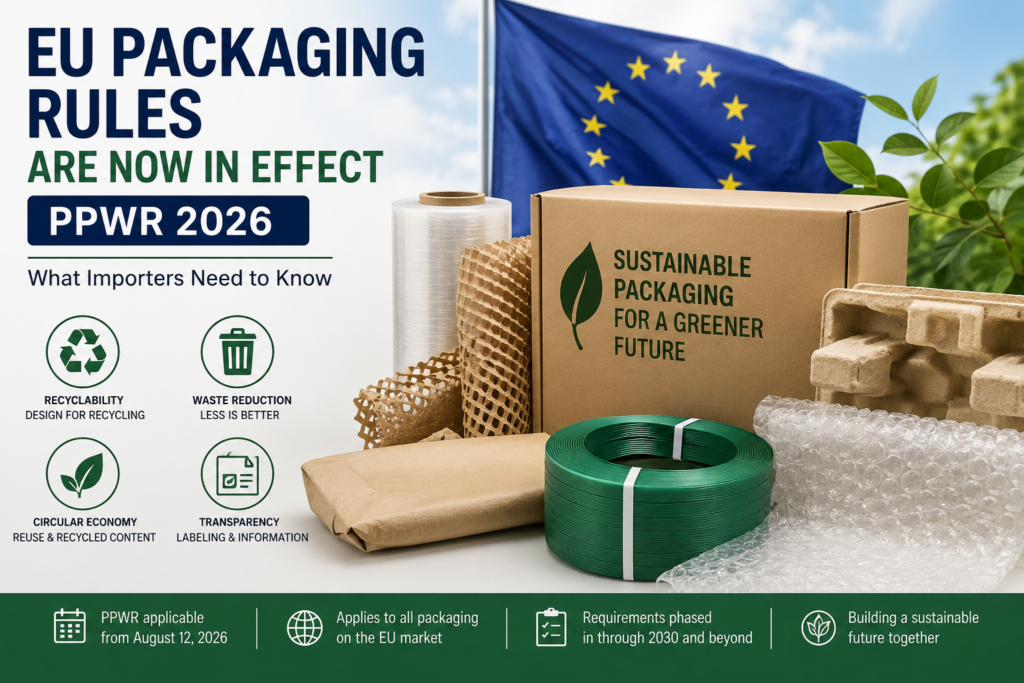
On August 12, 2026, the EU’s new Packaging and Packaging Waste Regulation—commonly known as PPWR—became generally applicable.
For importers, retailers, manufacturers and overseas suppliers selling products into the European Union, this is an important change.
But it is also important to understand what August 12 actually means.
PPWR becoming applicable does not mean that every recycling target, labelling rule or packaging requirement scheduled for the coming years suddenly became mandatory on the same day.
Instead, PPWR introduces a long-term transformation of how packaging is designed, manufactured, used, collected and recycled across the European market.
Some requirements apply now.
Others will be introduced gradually toward 2030, 2035 and beyond.
For companies importing furniture and other large consumer products into Europe, the most useful question is therefore not:
“Do we need to replace all our packaging immediately?”
The better question is:
“Is the packaging system we use today moving in the same direction as Europe’s future packaging requirements?”
That is where preparation should begin.
1. What Happened on August 12, 2026?
Regulation (EU) 2025/40 on packaging and packaging waste entered into force in February 2025 and became generally applicable from August 12, 2026.
PPWR replaces the previous Packaging and Packaging Waste Directive and establishes a more harmonised regulatory framework across the European Union.
According to the European Commission, the regulation covers packaging regardless of the material used and applies to packaging and packaging waste across industrial, commercial, household and other sectors.
This distinction is important.
Packaging regulation is no longer something relevant only to supermarkets, food packaging or consumer retail boxes.
For the furniture industry, packaging can include many of the materials used simply to get a product safely from the factory to the customer.
2. What Furniture Packaging Can Be Affected?
Consider a typical international furniture shipment.
A single outdoor sofa may be protected by several different materials:
- cardboard cartons
- PE or OPP plastic bags
- EPE foam
- bubble wrap
- EPS protective foam
- kraft paper
- corner protectors
- plastic straps
- stretch wrapping
- wooden pallets or transport protection
A gas fire pit may use another combination:
- plastic protective bag
- EPS foam
- cardboard carton
- straps
- pallet wrapping
From a factory perspective, these materials have traditionally been selected primarily for one purpose:
protect the product during transportation.
That purpose remains essential.
A regulation that reduces packaging but causes more furniture to arrive damaged would obviously create another form of waste.
However, PPWR introduces additional questions.
How much packaging is actually necessary?
Can the materials be recycled?
Can unnecessary layers be eliminated?
Are hazardous substances properly controlled?
Can different materials be separated?
Can packaging dimensions be optimized?
These questions are gradually becoming part of packaging design itself.
3. PPWR Is Now Applicable — But Compliance Is a Timeline
This is probably the most important point for importers to understand.
August 12, 2026 is not the deadline for every PPWR requirement.
The regulation contains many requirements with different implementation dates.
Some provisions apply from 2026, while others depend on future delegated or implementing acts. Major recyclability, recycled-content, packaging-minimisation and reuse requirements are introduced progressively over the coming years.
The European Commission has already published guidance addressing implementation questions surrounding PPWR.
Importers can follow the regulation itself through the official EUR-Lex text of Regulation (EU) 2025/40.
This gradual approach is important for businesses.
It means companies should neither panic nor ignore the regulation.
2026 should be treated as the beginning of a transition.
4. Recyclability Will Become Increasingly Important
One of the central objectives of PPWR is to make packaging placed on the EU market recyclable.
But “recyclable” under the future PPWR framework will increasingly mean more than simply saying:
“This material can theoretically be recycled.”
Packaging will eventually need to meet specific Design for Recycling criteria.
Future recyclability performance grades and technical criteria will be established through further EU rules.
The transition then continues toward another important concept:
recycled at scale.
In simple terms, Europe is moving toward a system where packaging should not only be technically recyclable in a laboratory or in theory—it should increasingly work within real recycling systems.
This is an important distinction.
A package composed of several individually recyclable materials may still create recycling difficulties if those materials are permanently bonded together or difficult for the consumer or waste operator to separate.
For furniture manufacturers, this encourages simpler and more thoughtful packaging structures.
5. What About Plastic Packaging?
Plastic packaging deserves particular attention.
Furniture exporters frequently use plastics because they provide inexpensive and effective protection against:
- dust
- moisture
- scratching
- abrasion
- impact
Completely eliminating plastics is therefore not always practical.
And PPWR should not simply be interpreted as:
“Plastic packaging is prohibited.”
That would be incorrect.
The more important direction is toward reducing unnecessary packaging, improving recyclability and increasing circular use of materials.
For manufacturers, this creates an opportunity to examine whether several different layers are genuinely necessary.
For example:
OPP bag + EPE foam + bubble wrap + kraft paper + carton
may be appropriate for certain fragile products.
But for another product, one or two of those layers might serve essentially the same protective function.
The objective should be:
Use enough packaging to protect the product properly—but avoid packaging that provides no meaningful additional protection.
That principle benefits both environmental performance and packaging cost.
6. PFAS and Heavy Metals: Avoid Oversimplifying the Rules
Chemical compliance is another area where confusion can easily occur.
PPWR contains restrictions relating to substances of concern, including limits connected with heavy metals in packaging.
PFAS has also received significant attention in European packaging discussions.
However, companies should be careful with broad statements such as:
“All packaging exported to Europe must now undergo PFAS testing.”
That is not an accurate description of the current PPWR requirements.
Specific PPWR PFAS concentration limits are particularly relevant to food-contact packaging.
Furniture packaging is a different application.
This does not mean chemical safety can be ignored.
Instead, manufacturers should understand the actual composition of the packaging materials they purchase and maintain appropriate supplier information and compliance documentation where required.
The European Chemicals Agency provides additional information about broader European chemical regulation through ECHA.
The practical lesson is simple:
test because a requirement or material risk justifies testing—not because a regulation has been misunderstood.
7. New Packaging Labels Are Coming — But Not All Are Required Today
PPWR also introduces a more harmonised approach to packaging labelling.
The long-term objective is to make it easier for consumers to identify packaging materials and understand how they should be sorted.
However, the new harmonised labelling requirements are also being introduced according to a regulatory timeline.
Therefore, August 12, 2026 does not mean every carton entering Europe suddenly requires an entirely new PPWR label.
Businesses should follow the relevant implementing rules and effective dates as they are introduced.
This is another reason why importers should distinguish between:
PPWR becoming applicable
and
every future PPWR technical requirement becoming mandatory.
They are not the same thing.
8. Less Empty Space Will Become Part of Better Packaging Design
One PPWR direction is particularly relevant to furniture manufacturers:
reducing unnecessary empty space.
Under the future requirements, grouped packaging, transport packaging and e-commerce packaging will face limits on empty-space ratios, with important requirements applying from 2030.
For furniture companies, however, waiting until 2030 to think about packaging efficiency would make little commercial sense.
Furniture is bulky.
In international shipping, we do not only pay for the product.
We often pay for the space around the product.
A few centimetres added to every carton can become several additional cubic metres across an entire container.
That affects:
packaging cost → CBM → container utilisation → freight cost → landed cost
This means one of PPWR’s environmental objectives can align directly with commercial efficiency.
Better Packaging Can Also Mean Better Logistics
For furniture manufacturers, packaging optimization may involve:
- KD or knock-down structures
- removable legs
- stackable frames
- nesting chairs
- optimized carton dimensions
- fewer unnecessary protective layers
- packaging several components efficiently
- reducing unused carton space
The objective is not to make packaging weaker.
It is to make it smarter.
A well-designed package protects the furniture while using less material and less transportation space.
That is good environmental design.
It is also good business.
9. PPWR and EPR Are Not the Same Thing
This distinction is especially important for companies already selling into Europe.
Some businesses assume:
“We already have EPR registration, so our packaging is compliant with PPWR.”
That is not necessarily correct.
Although PPWR and Extended Producer Responsibility are connected within the broader packaging-waste framework, they address different compliance responsibilities.
In simplified terms:
PPWR
focuses on areas such as:
- packaging design
- material requirements
- recyclability
- packaging minimisation
- labelling
- reuse
- recycled content
- waste prevention
EPR
focuses more on producer responsibility, including areas such as:
- registration
- reporting
- packaging quantities
- fees
- financing collection and waste-management systems
An EPR registration does not automatically mean the physical packaging meets every PPWR requirement.
Similarly, designing recyclable packaging does not necessarily eliminate EPR obligations.
For businesses operating across several EU markets, both need to be considered.
10. Even the PPWR Rules Are Still Evolving
Another important development in 2026 shows why businesses should continue following regulatory updates rather than treating PPWR as a finished rulebook.
In February 2026, the European Commission adopted a measure concerning pallet wrapping and straps, exempting certain uses from the PPWR’s 100% reuse requirement.
The Commission explained that applying the reuse requirement in these cases could create disproportionate economic costs and practical difficulties.
The official announcement is available from the European Commission.
This is a useful example.
PPWR has ambitious environmental objectives.
But the implementation framework is also being adjusted as regulators consider how individual requirements interact with real industrial and logistics conditions.
For companies, this means:
follow the direction of the regulation—but also follow the details.
11. What Should Importers and Suppliers Do in 2026?
The first response to PPWR should not necessarily be:
“Replace all packaging immediately.”
Nor should it be:
“Send every packaging material to a laboratory tomorrow.”
A more practical first step is simply to understand what packaging you are currently using.
For example, companies can begin building a basic Packaging BOM (Bill of Materials).
For each product or packaging system, record:
Material → Weight → Function → Supplier → Recyclability → Available Documentation
A furniture manufacturer might discover that one product uses:
Cardboard carton
→ structural protection
PE bag
→ dust and moisture protection
EPE foam
→ surface and impact protection
Plastic strap
→ carton reinforcement
Once this information is visible, the next questions become much easier.
Is every material necessary?
Can any material be reduced?
Can a difficult-to-recycle material be replaced?
Can packaging dimensions be reduced?
Can suppliers provide better material documentation?
Can one protective layer replace two?
This is how compliance becomes manageable.
Understand first. Improve second. Test where necessary. Document the result.
12. Environmental Responsibility Should Begin Before Regulation Requires It
There is also a broader lesson behind PPWR.
Environmental protection should not begin only when a government publishes a new regulation.
For many years, rapid economic development around the world has been accompanied by enormous consumption of materials, energy and natural resources.
Packaging is only one visible part of that problem.
Environmental awareness needs to become more deeply embedded in everyday life—including in China, where consumers, manufacturers and businesses are increasingly participating in the transition toward more sustainable consumption and production.
But environmental responsibility is equally important in commercial behaviour.
When we design a product, select a material, choose a carton or decide how many layers of plastic to use, we are already making environmental decisions.
A business that considers these questions from the beginning will experience regulations such as PPWR very differently from a business that begins thinking about sustainability only when a new compliance deadline arrives.
For the first company, a new environmental regulation may require adjustments.
For the second, it can feel like a sudden crisis:
What do we need to change?
What needs to be tested?
Which materials are compliant?
How much will this cost?
The difference is not simply regulatory knowledge.
It is business awareness.
Sustainability Is Becoming Part of Good Business
PPWR should therefore be understood as more than another European compliance requirement.
It reflects a much broader global direction.
Governments may use different regulations.
Countries may establish different recycling systems.
Implementation timelines may vary.
But reducing waste, using resources more efficiently and making products and packaging more sustainable are increasingly becoming a global consensus.
For manufacturers, this does not mean sacrificing product protection or commercial efficiency in the name of environmental goals.
Often, the opposite is possible.
Less unnecessary packaging means lower material cost.
Smaller cartons mean better container utilization.
Better recyclable materials can simplify waste handling.
Better documentation reduces compliance uncertainty.
More thoughtful product design can reduce both transportation cost and environmental impact.
The best environmental improvements are often the ones that also make commercial sense.
At CG Outdoor Furniture, we believe sustainability should gradually become part of how products are designed, manufactured, packaged and transported—not simply a response to the latest regulation.
Businesses that develop this awareness early will not need to completely change direction every time environmental policy advances.
They will already be moving in the same direction.
Regulations may establish the deadline.
Responsible businesses should begin before the deadline arrives.
Last updated: August 16, 2026.
This article is intended for general industry information and does not constitute legal or regulatory advice. PPWR requirements vary according to packaging type, use, economic-operator role and implementation date. Businesses should consult the official EU legislation and qualified compliance professionals when determining their specific obligations.