What Most Buyers Don’t Realize About Factory Pricing
One of the shortest questions we receive is often the hardest to answer.
“How much?”
Usually, it arrives with a single image attached.
Maybe it’s a screenshot from Pinterest. Maybe it’s a photo from a hotel lobby. Sometimes it’s a picture downloaded from another supplier’s website.
No dimensions.
No quantity.
No destination.
No material specifications.
Just a photo and a simple question:
“Can you give me a price?”
From the buyer’s perspective, it seems straightforward. After all, most products today can be purchased online with a fixed price displayed immediately.
But custom outdoor furniture doesn’t work that way.
And that’s where many misunderstandings begin.
Furniture Is Not a Product Sitting on a Shelf
When you buy a coffee maker from Amazon or a dining set from Costco, the pricing has already been calculated.
The retailer has already purchased inventory, imported it, stored it in a warehouse, and determined the selling price.
You simply choose the product and place the order.
Working with a factory is completely different.
In most cases, the product doesn’t exist yet.
The factory is not selling inventory. It’s evaluating whether it can manufacture your specific requirements.
That process naturally requires more information than a retail purchase.
A sofa that looks simple in a photograph may have dozens of possible variations.
The frame could be aluminum or teak.
The cushions could use standard foam or quick-dry foam.
The fabric could be a basic outdoor textile or a premium Sunbrella collection.
Two sofas may look nearly identical in photos while having significantly different manufacturing costs.
That’s why responsible suppliers ask questions before providing prices.
They’re not making the process complicated. They’re trying to make the quotation accurate.
What Happens After You Send Us a Picture
Many buyers imagine that a salesperson simply looks at a product and replies with a price.
The reality is usually much more collaborative.
When a project arrives, the first step is understanding exactly what the customer wants.
Sometimes we need to determine whether the dimensions shown in the image are realistic.
Sometimes we need to verify whether a particular detail can actually be manufactured.
Other times we discover that the design shown in the photo would be difficult to ship internationally without modification.
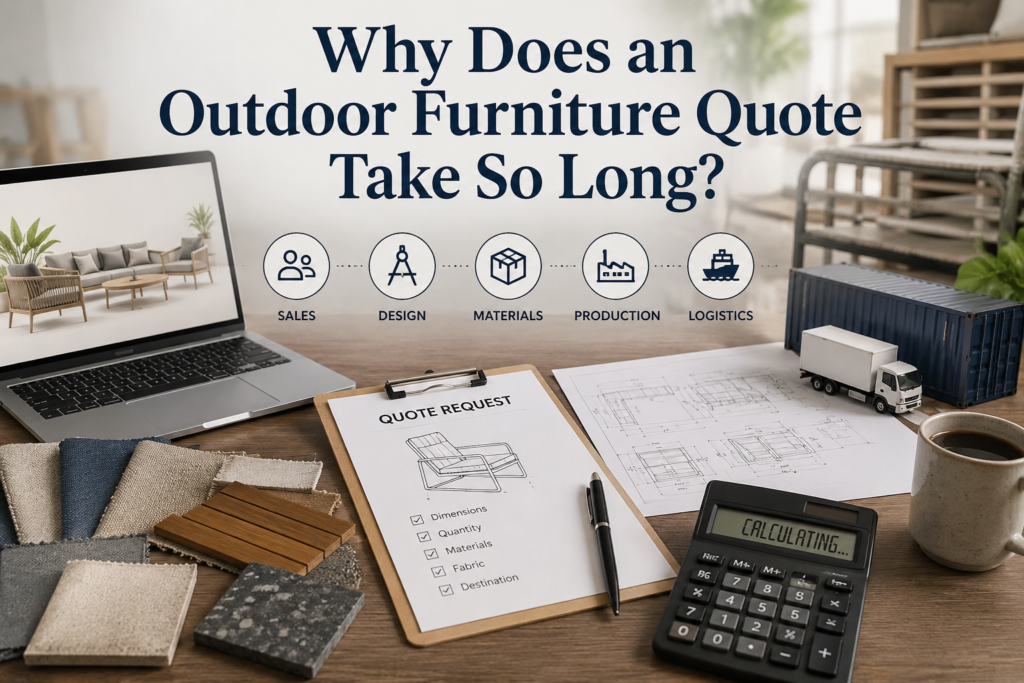
At that point, several people inside the company may become involved.
Engineers review structures.
Purchasing teams verify current material costs.
Production managers evaluate labor requirements.
Logistics teams estimate packaging and freight.
The final quotation is often the result of multiple conversations happening behind the scenes.
Most customers never see this process, but it plays a major role in ensuring the project can be completed successfully.
Why Quantity Changes Everything
Another common misunderstanding involves order quantity.
A customer may ask:
“How much for one chair?”
A week later, another customer asks:
“How much for 100 chairs?”
Although they are technically requesting the same product, the pricing logic is completely different.
Factories are designed around production efficiency.
When producing larger quantities, materials can be purchased more efficiently, production schedules become more streamlined, and packaging costs can be distributed across more units.
With very small orders, those efficiencies disappear.
The preparation work remains almost the same whether we manufacture one chair or one hundred.
This is one reason why factory-direct purchasing is often ideal for hotels, resorts, developers, and commercial projects, but not always the best choice for someone looking for a single chair.
Sometimes the Freight Costs Surprise Everyone
One of the most eye-opening conversations we have with new customers involves shipping.
Many people focus entirely on product cost.
Then they receive the freight estimate.
Outdoor furniture is unusual because it takes up a lot of space.
A chair may not weigh very much, but it still occupies a large carton.
A sofa may fit perfectly inside a container with dozens of other pieces, but become extremely expensive when shipped by itself.
We’ve seen situations where a customer wanted to purchase a single outdoor sofa from China, only to discover that the shipping cost was close to—or even higher than—the value of the sofa itself.
At that point, the question isn’t whether the factory can produce it.
The question becomes whether it’s the right purchasing strategy.

Why One Sofa Is Often Better Purchased Locally
This is something many factories rarely say openly.
If you only need one chair, one table, or one sofa set, buying locally is often the smarter option.
Retailers like Costco, Home Depot, Wayfair, and local furniture stores have already solved the logistics problem.
They import products in large quantities, store them locally, and distribute shipping costs across thousands of orders.
As a result, their pricing for small purchases is often difficult for factories to compete with.
That doesn’t mean factory purchasing is expensive.
It simply means the purchasing channel needs to match the project.
For a single patio set, local retail is usually more practical.
For a hotel project requiring fifty sets, the calculation changes completely.
Fast Quotes Are Easy. Accurate Quotes Take Time.
Occasionally, buyers ask why one supplier responds in ten minutes while another takes several days.
The answer is simple.
A quick quote is often based on assumptions.
An accurate quote is based on verification.
Both approaches can produce a number.
Only one is designed to support a successful project.
Over the years, we’ve learned that spending an extra day confirming details is usually far better than discovering unexpected costs after production has started.
Nobody enjoys revising prices later.
Neither the buyer nor the supplier.
That’s why we prefer to ask questions early, even if it makes the quotation process slightly longer.
How Buyers Can Help Speed Up the Process
The good news is that accurate quotations don’t always have to take a long time.
The more information you provide, the faster a supplier can work.
When requesting a quotation, it helps tremendously to include:
Product dimensions
Desired quantity
Preferred materials
Cushion and fabric requirements
Delivery destination
Target timeline
Even a simple sketch with approximate measurements can save days of back-and-forth communication.
The clearer the requirements, the faster the quotation process becomes.
A Quote Is More Than Just a Number
After years in manufacturing, we’ve come to see quotations differently than many buyers do.
A quote isn’t simply a price.
It’s a plan.
It’s the result of evaluating materials, labor, production capacity, packaging, logistics, and risk.
It’s the first step toward turning an idea into a finished product.
So the next time a supplier asks a few extra questions before providing a quotation, don’t assume they’re slowing things down.
They may simply be taking your project seriously.
And in manufacturing, that’s usually a good sign.