
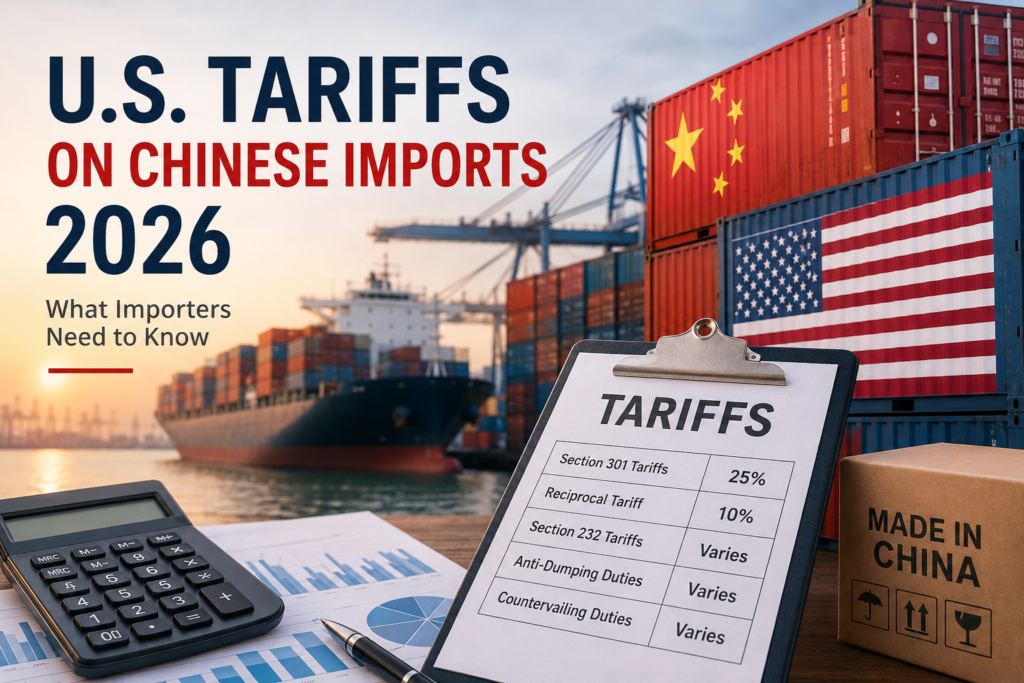
For U.S. importers sourcing products from China, tariffs have become a permanent part of landed-cost planning.
But the tariff story in 2026 is changing.
Over the past month, the United States has not announced another blanket tariff increase covering all Chinese imports. Instead, the focus is increasingly shifting toward maintaining existing tariffs, reviewing the long-running Section 301 measures, and strengthening enforcement around country of origin and transshipment.
One particularly important development is happening right now: the United States has entered the second four-year review of the Section 301 tariffs on Chinese imports, with one of the key continuation-request periods closing on August 22, 2026.
For furniture importers, wholesalers, retailers, hospitality buyers and other businesses sourcing from China, this is an important moment to understand what is actually changing—and what is not.
What Has Changed Recently?
The biggest misconception surrounding U.S.–China tariffs is that every new trade announcement means another tariff increase on all Chinese goods.
That is not what is happening right now.
Instead, three developments deserve attention:
- Section 301 tariffs are entering their second statutory four-year review.
- Existing tariffs remain an important part of U.S. import costs.
- Country-of-origin and transshipment enforcement is becoming increasingly important.
In other words, the U.S.–China tariff discussion in 2026 is becoming less about one headline tariff number and more about how existing tariffs are maintained, reviewed and enforced.
For importers, this distinction matters.
1. Section 301 Tariffs Are Entering Another Important Review Period
Many of the tariffs that U.S. importers currently associate with Chinese products originated from the Section 301 investigation launched in 2017 and the tariff actions that followed beginning in 2018.
These measures have now been in place for approximately eight years.
Under U.S. law, Section 301 actions are subject to a four-year review process. The Office of the United States Trade Representative (USTR) announced in May 2026 that it was initiating the second four-year review of the actions concerning China’s policies and practices related to technology transfer, intellectual property and innovation.
According to the official Federal Register notice, the review covers two major groups of tariff actions originally implemented in 2018.
For the action that originally took effect on July 6, 2018, the period for requesting continuation ran from May 7 through July 5, 2026.
For the action that originally took effect on August 23, 2018, the continuation-request period runs from June 24 through August 22, 2026.
That means the second review process is not something expected years from now.
It is happening right now.
Does This Mean Section 301 Tariffs Will Be Removed?
Not necessarily.
A four-year review should not be interpreted as an automatic expiration date.
During the previous review, USTR ultimately decided to maintain the Section 301 actions while making modifications to tariffs affecting certain strategic sectors.
Importers can review the previous modification through the official Federal Register Section 301 notice.
Therefore, businesses planning purchases for 2027 should be cautious about building sourcing strategies around the assumption that Section 301 tariffs will simply disappear.
A more practical approach is to plan using the current tariff structure while continuing to monitor the review.
2. There Is No Single “China Tariff”
One of the most common misunderstandings we encounter when discussing sourcing with international buyers is the question:
“What is the tariff on products from China?”
Unfortunately, there is no single answer.
The actual duty paid when a Chinese product enters the United States can potentially consist of several layers:
Normal customs duty (MFN)
+ Section 301 additional tariff
+ applicable reciprocal tariff
+ possible Section 232 duties
+ possible anti-dumping or countervailing duties
= Actual import duty
Not every product is subject to every layer.
That is why the HTS classification of the product is extremely important.
For example, an aluminum outdoor chair, a teak dining table, an upholstered sofa and a gas fire pit may all be sold by the same furniture supplier, but they do not necessarily share the same HTS classification or tariff treatment.
Importers should therefore avoid using a simple assumption such as:
“Everything from China has a 25% tariff.”
The reality is more complicated.
The U.S. International Trade Commission provides the official Harmonized Tariff Schedule of the United States, where importers can research tariff classifications.
For final classification decisions, importers should work with their customs broker or other qualified customs professional.
3. The Current U.S.–China Tariff Arrangement Still Matters
The current tariff environment also reflects the broader trade arrangements reached between the United States and China.
Under the existing framework, the United States has maintained a 10% reciprocal tariff on Chinese imports, while suspending a higher reciprocal tariff level through November 10, 2026.
More information on the arrangement is available from the White House fact sheet on U.S.–China economic and trade relations.
Separately, USTR has also extended certain exclusions from the Section 301 tariffs through November 10, 2026.
The official announcement can be found through the Office of the United States Trade Representative.
For businesses purchasing from China, this creates an important planning point later this year.
November 10, 2026 Is a Date Importers Should Watch
Several elements of the current U.S.–China trade arrangement reach an important policy milestone around November 10.
Importers placing orders in August, September or October should pay attention because the actual arrival date of the cargo may occur much later.
This is especially relevant for bulky products such as furniture.
A typical sourcing timeline might include:
30–45 days production
→ ocean transportation
→ U.S. customs clearance
→ domestic delivery
Therefore, tariff planning should not begin when the container reaches the port.
It should begin before the purchase order is confirmed.
4. The Bigger Issue May Be Enforcement, Not New Tariffs
Another important development deserves attention.
The United States is increasingly focusing on transshipment and tariff circumvention.
In August 2026, the White House published material specifically addressing what it describes as tariff evasion through third-country transshipment.
The document, The Great Transshipment Scam, highlights U.S. concerns about goods being routed through countries with lower tariff rates before entering the American market.
This matters enormously for global sourcing.
For several years, many companies responded to U.S.–China tariffs by moving portions of their supply chains to:
- Vietnam
- Indonesia
- Malaysia
- Thailand
- India
- Mexico
- other manufacturing countries
Supply-chain diversification itself is perfectly normal.
The compliance issue arises when goods manufactured in one country are simply routed, repacked or minimally processed in another country and declared as originating from the second country.
Shipping From Vietnam Does Not Automatically Mean “Made in Vietnam”
Consider a simplified furniture example.
Suppose an outdoor furniture frame is manufactured in China and then shipped to another country where it is only packed into cartons before being exported to the United States.
Changing the shipping country does not automatically change the product’s country of origin.
The key question becomes whether sufficient manufacturing or substantial transformation has occurred.
For importers, this means that the question:
“Which country is the container shipped from?”
is increasingly less useful than:
“Where was the product actually manufactured?”
This distinction will become increasingly important as global furniture supply chains diversify.
5. What Does This Mean for Furniture Importers?
For furniture buyers, the current tariff environment does not necessarily mean that sourcing from China is no longer competitive.
It does mean that sourcing decisions need to become more sophisticated.
Calculate Landed Cost—not Just FOB Price
Comparing suppliers purely on FOB price can produce misleading results.
A better comparison is:
**Product cost
- ocean freight
- customs duties
- additional tariffs
- customs clearance
- inland transportation
= Landed cost**
A supplier offering a lower factory price does not necessarily provide the lowest final cost.
Conversely, a product carrying a higher tariff may still be commercially competitive if its production cost, quality, lead time and logistics efficiency are significantly better.
6. HTS Classification Is Becoming Part of Sourcing Strategy
Historically, many buyers considered tariff classification primarily a customs-clearance issue.
Today, it should be considered much earlier.
Imagine that a hospitality project requires:
- teak dining tables
- aluminum dining chairs
- outdoor sofas
- umbrellas
- fire pits
- cabinets
- mirrors
These products may come from the same sourcing project, but their tariff classifications can be completely different.
This is why professional buyers increasingly calculate tariff exposure before confirming large orders.
For higher-volume purchasing, checking the likely HTS classification during quotation can prevent unpleasant surprises later.
7. Moving Production Out of China Is Not Always the Simple Answer
The tariff environment has encouraged global supply-chain diversification.
But diversification does not necessarily mean completely abandoning China.
China still has an extremely mature furniture manufacturing ecosystem covering:
- aluminum extrusion
- powder coating
- teak processing
- stainless-steel hardware
- outdoor fabrics
- PE wicker
- rope
- foam and cushions
- glass
- stone
- packaging
- molds and tooling
For many furniture categories, the supply chain behind one finished product can involve dozens of specialized manufacturers.
Replicating the entire ecosystem in another country takes time.
As a result, many international buyers are gradually moving from a sourcing model of:
China OR Southeast Asia
toward:
China + Southeast Asia + other manufacturing regions
The goal is not simply to chase the lowest tariff.
The goal is to balance:
cost + tariff + quality + capacity + lead time + compliance + supply-chain risk.
8. Tariffs Change the Cost Equation — Not the Value of Chinese Manufacturing
Tariffs undoubtedly increase the cost of importing certain products from China.
But higher tariffs do not automatically make another manufacturing country a better sourcing choice.
For many product categories—especially furniture, customized products and design-driven products—the real value of a manufacturing base goes far beyond labor cost.
China has spent decades developing one of the world’s most complete manufacturing ecosystems. Materials, components, machinery, skilled workers, engineers, craftsmen, packaging suppliers and logistics networks often exist within the same industrial region.
This ecosystem allows manufacturers to do something particularly important:
turn ideas into real products.
Manufacturing Is More Than Assembly
This becomes especially clear with customized furniture.
A designer may begin with nothing more than a rendering, a photograph or a hand-drawn sketch.
Turning that idea into a finished product may require decisions about structural engineering, woodworking, welding, bending, polishing, weaving, upholstery, stone fabrication, glass processing, hardware and finishing.
Many of these decisions cannot be solved by drawings alone.
They depend on the experience of the people actually making the product.
An experienced carpenter knows how wood will behave.
A skilled upholsterer understands how fabric needs to stretch around a curved frame.
An experienced welder can recognize when a beautiful design requires additional structural support.
A skilled weaving worker can translate an unusual pattern into something that can actually be produced consistently.
These capabilities are difficult to measure on a quotation sheet, but they can have enormous influence on the final product.
The Experience Behind China’s Manufacturing Base
Over several decades, Chinese manufacturing has accumulated an enormous amount of practical production knowledge.
This includes not only factories and machinery, but also the experience of millions of skilled workers, technicians, engineers and craftsmen.
Many Chinese manufacturers have also established factories in Vietnam and other Southeast Asian countries as global supply chains have diversified.
These regions are developing quickly and will continue to play an important role in global manufacturing.
However, moving equipment into another country does not immediately reproduce decades of accumulated skills, supplier coordination, production efficiency and craftsmanship.
Manufacturing capability is ultimately built by people.
And experience takes time.
This is one reason China remains particularly competitive in products that require customization, complicated construction, multiple materials or a high degree of craftsmanship.
9. The Better Sourcing Strategy: Balance Tariffs, Quality and Product Value
For importers, the objective should therefore not be simply to find the country with the lowest tariff or the factory offering the lowest FOB price.
The more useful question is:
Can this product still generate a healthy margin after its total landed cost is considered?
Consider a simplified example.
Supplier A offers a product for $100.
Supplier B offers a similar-looking product for $120.
At first glance, the cheaper product appears to be the obvious choice.
But if the $120 product has better construction, more consistent finishing, a longer service life and can retail successfully at $300 instead of $220, the purchasing decision looks very different.
This is why tariff discussions should ultimately return to basic business economics:
Landed Cost + Product Quality + Market Positioning + Selling Price = Sustainable Margin
Tariffs are a cost barrier.
They should be calculated carefully.
But they should not become the only factor determining where a product is manufactured.
Competing on Quality Instead of Chasing the Lowest Price
There is another important lesson for both manufacturers and importers.
As tariffs increase the cost of international sourcing, endlessly pursuing the lowest possible factory price becomes less sustainable.
Reducing a product by another few dollars may eventually require compromises in materials, construction, finishing or quality control.
For design-driven furniture in particular, this can be counterproductive.
A better strategy is often to move in the opposite direction:
create better products.
Better materials.
Better craftsmanship.
Better engineering.
Better durability.
Better design execution.
And ultimately, better value for the end customer.
When a product has sufficient differentiation and quality, purchasing decisions become less sensitive to small differences in factory price.
10. China’s Opportunity Is Moving Toward Higher-Value Manufacturing
For many years, China’s manufacturing advantage was commonly associated with low production costs.
That description is becoming increasingly outdated.
China’s stronger competitive advantages today increasingly include:
manufacturing depth, supply-chain completeness, production experience, engineering capability, customization and craftsmanship.
This evolution is particularly relevant to the furniture industry.
Furniture is not a standardized electronic component.
It combines industrial manufacturing with craftsmanship.
A single outdoor sofa may involve aluminum fabrication, welding, powder coating, woodworking, weaving, sewing, foam cutting, upholstery and final assembly.
A customized hospitality project can involve dozens or even hundreds of different specifications.
The ability to coordinate these processes efficiently—and turn a designer’s concept into a commercially manufacturable product—is difficult to replace purely through lower labor costs.
For Chinese manufacturers, this also points toward the future.
The opportunity is no longer simply:
Make it cheaper.
It is increasingly:
Make it better.
For international buyers, the same principle applies.
The goal should not necessarily be to purchase the cheapest product available.
The goal is to find the manufacturing partner capable of delivering the right combination of cost, craftsmanship, quality, reliability and product value.
Tariffs can change the calculation.
They do not erase the manufacturing capability behind the product.
Last updated: August 16, 2026.
This article is provided for general industry information only and should not be considered customs, tax or legal advice. Tariff treatment depends on product classification, country of origin and other circumstances. Importers should confirm applicable duties with a licensed customs broker, trade attorney or the relevant U.S. government authority before importing.
Official Sources & Further Reading
- Office of the United States Trade Representative (USTR)
- Federal Register — Second Four-Year Review of China Section 301 Actions
- U.S. International Trade Commission — Harmonized Tariff Schedule
- U.S. Customs and Border Protection — Trade
- White House — U.S.–China Economic and Trade Relations
- White House — The Great Transshipment Scam, August 2026