
Don’t Wait Until Winter: Why Fireplace Buyers Should Order 3–6 Months Ahead
Quick Answer
When should retailers and distributors order indoor fireplaces for the winter season?
For imported indoor fireplaces and wood-burning stoves, buyers should generally begin planning inventory 3–6 months before their expected selling season. Production, ocean freight, customs clearance, inland delivery, and unexpected delays all need to be included in the timeline.
For the 2026 winter season, August and September are already important ordering months. As seasonal demand increases, CG Outdoor’s fireplace production schedule has extended to 70 days or more, making early inventory planning especially important.
The Best Time to Buy Fireplaces Isn’t Winter
Every year, we see the same pattern.
Temperatures begin to fall.
Consumers start thinking about heating their homes.
Search interest in fireplaces and wood-burning stoves rises.
Retailers notice inventory moving faster.
And suddenly, everyone wants to reorder.
Unfortunately, that’s often the worst time to begin sourcing fireplaces.
For retailers, distributors, wholesalers, and project buyers importing fireplaces internationally, purchasing can’t follow consumer demand in real time.
By the time consumers want the product, your inventory should already be in your warehouse.
That means the real fireplace buying season starts months before winter arrives.
Work Backward From the Selling Season
A common purchasing mistake is calculating only the factory’s production time.
But the factory is only one part of the supply chain.
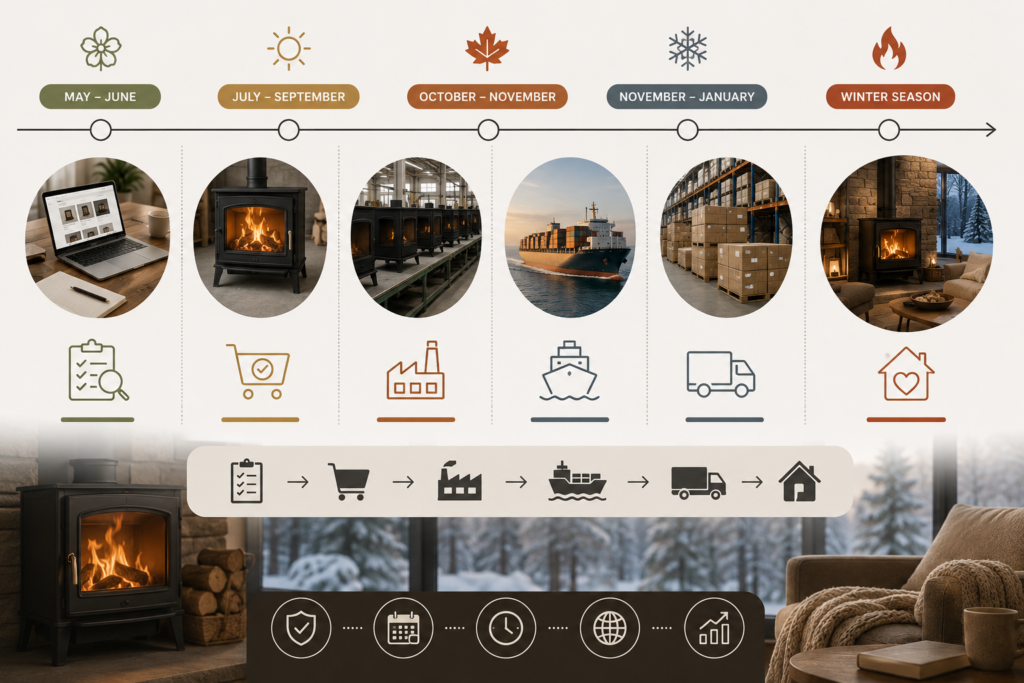
A typical international fireplace order may involve:
Production
↓
Inspection & Packing
↓
Container Loading
↓
Ocean Freight
↓
Customs Clearance
↓
Inland Transportation
↓
Warehouse Receiving
↓
Retail / Distribution
Only after all of these steps are complete is the fireplace actually available for sale.
That’s why experienced buyers plan backward from the date they want inventory available—not forward from the date they place the order.
Why August and September Matter
August may still feel like summer, but for fireplace suppliers, the winter season has already begun.
As distributors and retailers around the world prepare their seasonal inventory, factory capacity starts filling quickly.
This creates a simple supply-and-demand problem.
More orders enter production at approximately the same time, while manufacturing capacity remains limited.
As a result, lead times increase.
During normal periods, fireplace production schedules may be relatively flexible. During the seasonal peak, however, production queues become significantly longer.
CG Outdoor’s current fireplace production lead time has increased to more than 70 days as we enter the August–September peak ordering period.
And those 70+ days only cover production.
The fireplaces still need to reach the customer.
Production Time Is Only Half the Timeline
International buyers should always consider transportation when planning seasonal inventory.
Ocean freight can easily add several additional weeks to the purchasing cycle.
Depending on the destination, route, port congestion, customs procedures, and final delivery arrangements, the total timeline can become much longer than expected.
Consider a simplified example:
| Stage | Approximate Planning Time |
| Production during peak season | 70+ days |
| Inspection, packing & loading | Several days |
| Ocean transportation | Approx. 6–8 weeks* |
| Customs & inland delivery | Varies by destination |
| Warehouse / retail preparation | Additional buffer recommended |
Actual transit times vary by destination, shipping route, carrier, and seasonal conditions.
Suddenly, an order that appears to require “70 days” can easily become a four- or five-month inventory cycle.
That’s why ordering three to six months ahead isn’t overly cautious.
For seasonal products, it’s simply good inventory planning.

What Happens If You Wait Until Winter?
Imagine demand for fireplaces begins rising strongly in November.
A retailer notices sales increasing and places a new international order.
If production takes more than 70 days, the goods may not leave the factory until January or February.
Add ocean freight, customs clearance, and delivery.
The fireplaces could arrive when winter is already ending.
The product itself may be excellent.
The price may be competitive.
The order may arrive exactly as promised.
But commercially, the timing is wrong.
And with seasonal products, the right product arriving at the wrong time can still become the wrong inventory.
Seasonal Inventory Is About Selling Windows, Not Just Delivery Dates
This is an important distinction.
A buyer shouldn’t ask only:
“When will my fireplaces arrive?”
A better question is:
“When do I need them available for customers?”
If your strongest sales period begins in October, receiving inventory at the end of October may already be too late.
You may need time for:
- Warehouse receiving
- Product photography
- Website updates
- Dealer distribution
- Showroom setup
- Marketing campaigns
- Pre-season promotions
Ideally, inventory should be ready before demand peaks, not while demand is already peaking.
Why We Recommend Planning 3–6 Months Ahead
There isn’t one ordering date that works for every fireplace buyer.
A large distributor ordering containers has different requirements from a boutique retailer or a hospitality project.
But as a general planning principle, we recommend beginning the purchasing process three to six months before the intended selling or installation period.
The additional time provides flexibility for production and logistics while also creating a buffer for unexpected delays.
Early planning can also give buyers more flexibility when discussing:
- Models and quantities
- Finishes
- Packaging
- Private labeling
- Certification requirements
- Container planning
- Shipping schedules
When production is already operating at peak capacity, flexibility naturally becomes more limited.
A Simple Fireplace Inventory Planning Timeline
If your main selling season begins around November, a practical planning schedule might look like this:
May–June
Review last season’s sales, forecast demand, and identify models that need replenishment.
June–July
Confirm product specifications, certification requirements, packaging, and estimated quantities.
July–September
Place production orders and secure factory capacity.
September–November
Production, inspection, shipment, customs clearance, and warehouse receiving take place according to the individual order schedule.
Before Peak Winter Demand
Inventory is already available for dealers and customers.
The exact timeline will vary, but the principle remains the same:
Plan backward from the day you want to sell—not forward from the day you order.
Don’t Forget Your Best-Selling Models
Early planning doesn’t necessarily mean predicting every unit you’ll sell months in advance.
Buyers can start with the products they understand best.
Review last winter’s sales.
Which fireplace models sold fastest?
Which sizes generated repeat orders?
Which finishes performed best?
Which products ran out earlier than expected?
Those products provide a logical starting point for the next season’s inventory.
A good purchasing strategy isn’t about stocking everything.
It’s about making sure your most important products are available when customers actually want them.
Early Ordering Gives Everyone More Flexibility
There is another advantage to ordering before the seasonal rush: options.
When factory schedules are less congested, buyers and manufacturers generally have more room to coordinate production, packaging, inspections, shipping, and container loading.
Once the peak season arrives, every week matters.
A delayed confirmation can mean moving into the next available production slot.
A missed vessel can add additional transit time.
Small delays begin stacking on top of each other.
Planning early creates breathing room throughout the entire supply chain.
Your Winter Sales Season Starts Months Before the First Cold Day
Consumers can wait until temperatures drop before thinking about fireplaces.
Professional buyers cannot.
For retailers, distributors, wholesalers, and project buyers, winter preparation begins while customers are still enjoying summer.
That’s the nature of seasonal inventory.
At CG Outdoor, August and September are already part of our peak fireplace production period, and our current production schedule has extended to more than 70 days. We encourage our partners who are preparing winter inventory to review their requirements as early as possible and allow sufficient time for both manufacturing and international transportation.
Our goal isn’t simply to manufacture fireplaces on time.
It’s to help our partners have the right products in the right market, at the right moment.
Plan Early. Sell in Season.
The best fireplace inventory is not the inventory that arrives fastest.
It’s the inventory that arrives before your customers need it.
Planning three to six months ahead gives buyers time to manage production, transportation, customs, warehousing, and unexpected delays without sacrificing the most valuable weeks of the winter selling season.
If you’re preparing indoor fireplace or wood-burning stove inventory for the coming winter, August and September are the time to act—not the time to wait for colder weather.
Because when the first cold days arrive, your fireplaces shouldn’t still be crossing the ocean.
They should already be ready for your customers.