Furniture Sample Approval: What Buyers Should Check Before Mass Production
A furniture sample can look excellent and still be unready for production.
That distinction matters.
For a project buyer, the purpose of a sample is not simply to answer:
“Do I like this chair?”
It should answer a more important question:
“Is this exactly what we want the factory to reproduce across the entire order?”
Once a custom furniture project moves into mass production, small unresolved details can become hundreds of repeated details. A cushion that is 20 mm too thick on one prototype is easy to change. The same problem across 200 sofas is not.
For international buyers, sample approval should therefore be treated as a technical milestone rather than a visual formality.
1. Check the Overall Proportion Before the Details
Start by viewing the furniture as a complete object.
Does it have the same visual proportion as the approved design?
A technically correct dimension does not always produce the intended visual result.
A sofa can have the correct overall width but still look too heavy because the arms are wider than expected. A dining chair may meet the drawing dimensions while the back appears visually too upright.
Before measuring individual components, ask:
- Does the silhouette match the design intent?
- Does the scale feel appropriate?
- Are the seat, back and arms visually balanced?
- Does it work with the surrounding furniture?
Only then move to detailed measurements.
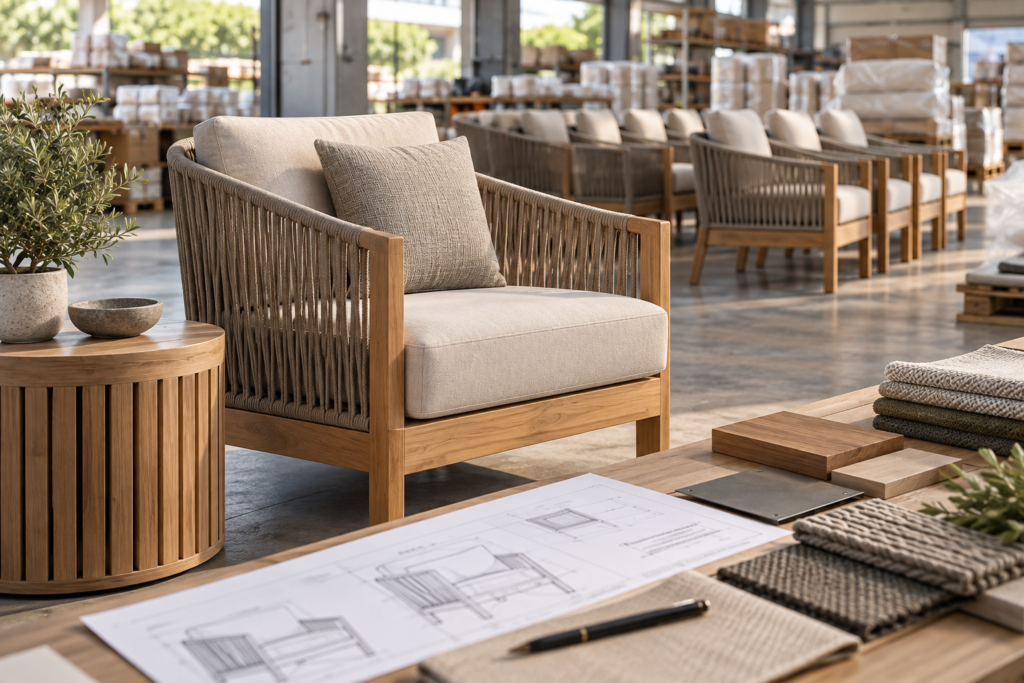
2. Measure the Sample Against the Approved Drawing
Reference photographs should not become the final production standard.
The approved drawing should.
For seating, check dimensions such as:
- overall width
- overall depth
- overall height
- seat height
- seat depth
- arm height
- back angle
- cushion thickness.
For tables, confirm:
- overall length and width
- Height
- top thickness
- leg position
- clearance beneath the table.
Small dimensional differences can influence comfort, appearance and installation.
They can also affect packaging and container loading.
Mark every confirmed measurement on the final drawing rather than relying on email discussions scattered across a long project thread.
3. Sit on the Furniture
This sounds obvious, but furniture samples are sometimes evaluated primarily through photographs.
For seating, comfort is part of the specification.
Evaluate:
- Seat height. Is it easy to sit down and stand up?
- Seat depth. Does the back cushion support the user naturally?
- Back angle. Does the body feel supported or pushed forward?
- Cushion firmness. Is it appropriate for residential, restaurant or hospitality use?
- Arm position. Does it feel natural?
A hotel lounge sofa and an outdoor dining chair serve very different functions.
Comfort should match the intended use—not simply feel “soft.”
4. Inspect the Furniture From Every Angle
Premium furniture must work beyond its hero photograph.
Walk around the sample.
Look at:
the back, sides, underside, corners, seams and transitions between materials.
This is especially important for hospitality furniture because pieces are often visible from multiple directions.
A sofa positioned against a residential wall may hide its rear construction.
A sofa in the center of a hotel lobby or terrace does not.
The back is part of the design.
5. Confirm the Actual Materials
A sample approval should establish the material standard that mass production will follow.
For a teak product, confirm the wood appearance and finish.
For aluminum, check the profile, surface preparation and powder-coat appearance.
For rope furniture, inspect:
- rope diameter
- weaving density
- Tension
- Color
- pattern consistency.
For upholstery, confirm the actual fabric reference—not merely “beige” or “grey.”
Where natural materials are used, buyers should also understand that reasonable grain and color variation may occur.
The objective is not to eliminate natural variation.
It is to define what variation is acceptable.

6. Pay Close Attention to Color Under Different Light
Color approval from a phone screen is risky.
Warm indoor lighting can make a neutral fabric appear beige.
Outdoor daylight can reveal that it is actually grey.
Powder coating, timber finishes, fabrics and rope should ideally be reviewed under lighting representative of the final environment.
For large custom projects, retain approved physical samples where practical:
- fabric swatch
- rope sample
- wood finish panel
- metal color chip.
These become valuable production references.
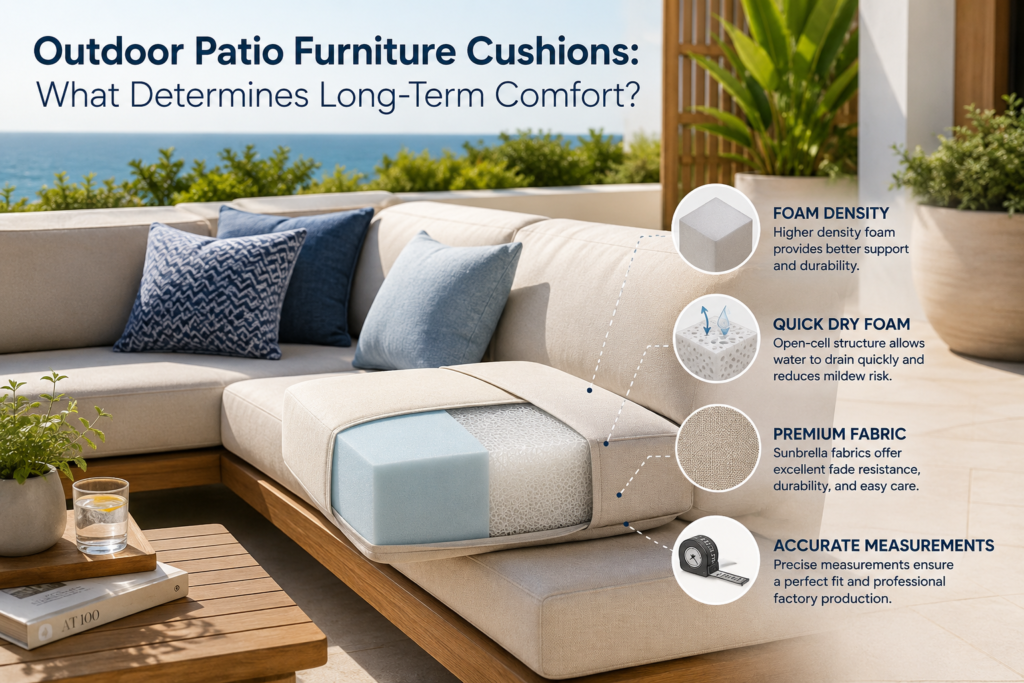
7. Cushion Construction Deserves Separate Approval
Cushions can significantly change the appearance of furniture.
Check:
- finished dimensions
- foam firmness
- crown or loft
- seam position
- Piping
- zipper location
- fabric tension
- attachment method.
Look especially at the relationship between multiple cushions.
Two seat cushions should meet cleanly.
Back cushions should not leave unintended gaps.
Corners should appear deliberate rather than compressed or overfilled.
The goal is not to make every soft product mathematically identical.
It is to establish a repeatable visual standard.
8. Test the Details Buyers Usually Notice Later
Some issues become obvious only after the furniture is used.
- Does the chair wobble?
- Does the table remain stable when pressure is applied near the edge?
- Do modular sofa sections stay aligned?
- Do cushions slide forward?
- Are connectors easy to operate?
- Do adjustable components move smoothly?
- Does hardware remain visually discreet?
These small functional details can have a disproportionate effect on how customers perceive quality.
9. Review Workmanship at Close Range
Inspect areas where manufacturing quality becomes visible:
- Welds
- wood joints
- Sanding
- edge treatment
- Stitching
- rope terminations
- fabric seams
- hardware installation
- powder coating around corners and joints.
One minor imperfection on a handmade sample does not necessarily predict a production problem.
A repeated construction weakness does.
The question is whether the process can be reproduced consistently.
10. Do Not Forget Packaging
The sample approval stage is also an excellent time to review packaging.
Ask:
How will exposed corners be protected?
Can finished surfaces rub against packaging?
Are cushions protected from moisture and dirt?
Will assembly hardware be secured?
Does the carton or wrapping method suit FCL or LCL shipping?
Can the packaging survive warehouse handling after arrival?
A perfectly manufactured product can still reach the customer damaged if packaging is treated as an afterthought.
11. Create an Approval Record
After the sample is approved, create a clear record.
The production standard may include:
- final drawings
- dated sample photographs
- approved material samples
- fabric code
- finish reference
- cushion specification
- hardware specification
- packaging instructions
- approved modifications.
If the buyer requests a change after sample approval, record it explicitly.
For example:
Approved sample except seat cushion thickness changes from 120 mm to 100 mm.
That is much safer than saying:
Everything looks good—just make the cushion slightly thinner.
12. One Sample Should Become the Production Benchmark
Where practical, the approved sample should remain available during production.
It becomes the reference against which production pieces can be compared.
This is particularly useful when appearance depends on several interacting details:
wood tone + rope color + cushion thickness + fabric tension + frame proportion.
Specifications provide numbers.
The approved sample shows how those numbers are supposed to work together.
Sample Approval Is Where Design Becomes a Manufacturing Standard
The prototype stage is one of the last opportunities to make changes relatively efficiently.
Use it.
Do not approve a sample simply because the overall appearance is attractive.
- Measure it.
- Sit on it.
- Photograph it.
- Inspect it.
- Compare it with the drawing.
- Confirm the materials.
- Review the packaging.
- Then document the result.
At CG Outdoor Furniture, the purpose of custom sampling is to progressively remove uncertainty before production begins. For project furniture, that process can be particularly important when multiple materials, custom dimensions and large quantities are involved.
A good sample is not merely a preview of the furniture.
It is the physical definition of what the order should become.