
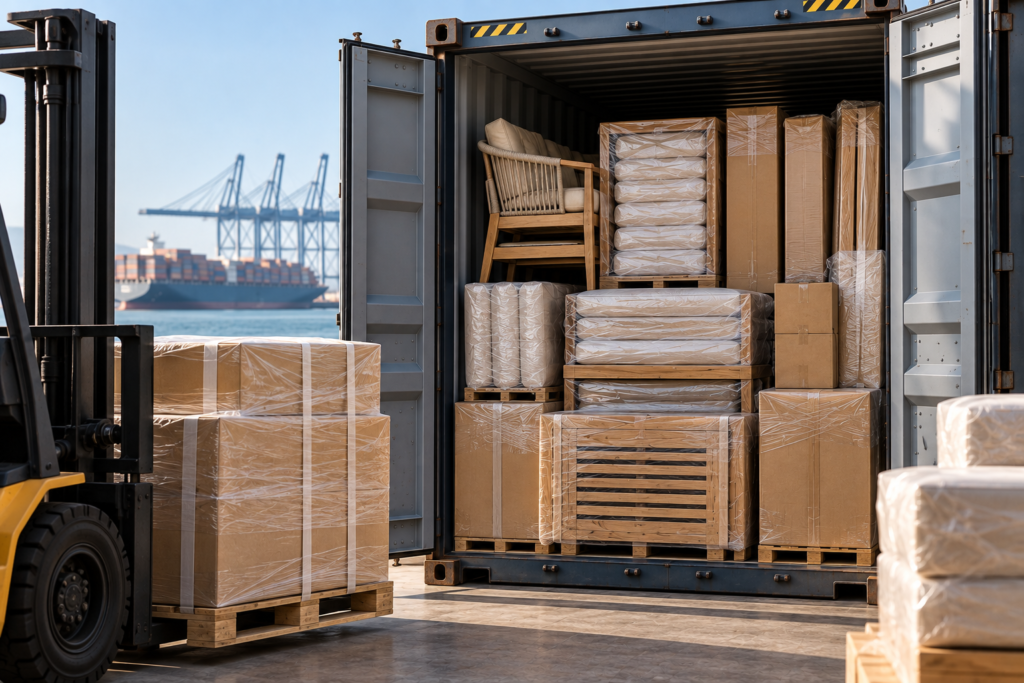
Two outdoor sofas can have almost identical factory prices.
Yet one can be significantly more expensive by the time it reaches the buyer’s warehouse.
The difference may have nothing to do with the furniture itself.
It may be air.
Furniture occupies a large amount of space relative to its weight, which means international furniture logistics is often constrained by container volume long before it reaches maximum container weight.
For importers, understanding CBM is therefore an important part of product development—not merely a shipping calculation performed after production.
What Is CBM?
CBM means cubic meter.
For a rectangular package:
Length × Width × Height = CBM
using dimensions in meters.
For example, a carton measuring:
1.20 × 0.80 × 0.70 m
occupies approximately:
0.672 CBM.
Multiply that across 100 pieces and the shipment occupies approximately 67.2 CBM before considering actual loading efficiency.
That is already close to the usable loading volume of many 40’HQ furniture shipments.
Factory Price Is Only One Part of Furniture Cost
A buyer comparing suppliers may see:
Supplier A: $420
Supplier B: $440
Supplier A appears cheaper.
But suppose Supplier A’s packaging occupies 0.85 CBM while Supplier B redesigns the product to occupy 0.58 CBM.
Across a large order, Supplier B may fit significantly more pieces into the same container.
The $20 factory-price difference may become insignificant compared with the freight difference.
This is why professional buyers increasingly evaluate:
cost per piece + packaging volume + container quantity.
Furniture Is Particularly Sensitive to Volume
Consider the geometry of a lounge chair.
Most of the volume underneath the seat is empty.
The space between the arms is largely empty.
The area behind the back may be empty.
If the chair ships completely assembled, the buyer is effectively paying ocean freight for all of that unused space.
This is why manufacturers consider:
stackability, knock-down construction, removable legs, nested components and cushion placement.
The challenge is achieving shipping efficiency without compromising structural integrity or making installation unnecessarily complicated.

Knock-Down Is Not Automatically Better
Flat-pack furniture can dramatically improve loading quantity.
But KD construction introduces additional considerations:
hardware, assembly time, structural joints, installation instructions and lost components.
For a retail product, this may be completely acceptable.
For a five-star hotel installing 300 chairs, extensive onsite assembly may create unnecessary labor.
The correct solution therefore depends on the project.
Sometimes fully assembled furniture is worth the additional CBM.
Sometimes semi-KD construction creates the best balance.
Cushions Occupy More Space Than Buyers Expect
Deep outdoor sofas often contain extremely large cushions.
The frame may nest efficiently while cushions consume the remaining container.
Compression can sometimes improve loading efficiency, but not every cushion construction should be aggressively vacuum-packed.
Certain foams and fillings may require recovery time.
Excessive compression can also affect shape.
Packaging should therefore balance:
volume efficiency + product recovery + moisture protection + presentation.
LCL and FCL Require Different Thinking
Packaging suitable for a full container may not be appropriate for LCL shipping.
In an FCL shipment, furniture is loaded at origin and generally remains inside the same container until destination.
LCL cargo passes through consolidation warehouses and can experience substantially more handling.
That may require:
stronger cartons, pallets, crates or additional corner protection.
The protective packaging increases CBM.
Therefore an 8 CBM furniture order may not remain 8 CBM after export packaging is added.
This is one reason very small furniture shipments can produce unexpectedly high landed costs.
Odd Shapes Create Invisible Lost Space
CBM calculations describe the volume of individual packages.
They do not automatically describe container utilization.
Curved sofas, oversized lounge chairs, irregular tables and assembled furniture can create voids that cannot be filled efficiently.
A shipment whose calculated packaging volume is 60 CBM may therefore use substantially more real container capacity.
Experienced loading teams try to combine products strategically.
For example:
chairs may fit underneath tables,
cushions may occupy sofa cavities,
smaller cartons may fill spaces around larger pieces.
This is why mixed furniture projects often require a container loading plan rather than a simple CBM total.
Packaging Is Part of Product Engineering
Packaging decisions should begin before production is complete.
A manufacturer can sometimes make small design adjustments that produce large logistical improvements.
Examples include:
removable table legs,
detachable sofa connectors,
stackable dining chairs,
nested side tables,
removable cushions,
optimized carton dimensions.
A few centimeters can matter.
If reducing one package dimension allows another layer of cartons to fit inside the container, loading quantity can change significantly.
Large Glass and Stone Products Are Different
Some furniture cannot be optimized purely around CBM.
Large mirrors.
Stone tabletops.
Glass panels.
Oversized architectural furniture.
These products may require vertical racks, A-frames, crates or specialized support.
The packaging itself may occupy substantial space because the primary objective is preventing breakage.
For fragile products, safe loading density is more important than theoretical maximum loading density.
Ask for Three Numbers
When evaluating a furniture quotation, professional buyers should request:
Unit price
Packing CBM per piece
Estimated loading quantity per container
Together, these numbers provide a much more realistic picture of sourcing cost.
For large projects, buyers can go one step further and estimate:
landed freight cost per piece.
This makes comparison between different product constructions far more meaningful.
Design and Logistics Should Talk to Each Other
A common mistake is separating furniture design from logistics.
The designer creates the product.
The factory manufactures it.
Only then does someone ask:
“How many fit in a container?”
By that stage, improving loading efficiency may require changing finished products.
A better process considers transportation during engineering.
Not enough to compromise design.
But early enough to identify unnecessary shipping volume.
The Most Efficient Product Is Not Always the Smallest Package
There is a balance.
Furniture exists to perform a function and create an experience.
Reducing a luxury lounge chair until it becomes uncomfortable simply to improve container loading makes no sense.
Likewise, weakening a table connection to make it knock-down can create long-term service problems.
The objective is not minimum CBM.
It is efficient CBM without sacrificing product quality.
Landed Cost Begins at the Drawing Stage
International furniture buyers often think freight begins when the container arrives at the factory.
In reality, freight economics begin much earlier.
They begin when someone decides:
whether the chair stacks,
whether the table legs detach,
how deep the sofa is,
how cushions are packed,
and whether the product can nest.
Those are design decisions.
But they are also logistics decisions.
At CG Outdoor, packaging and container loading are considered alongside furniture construction, particularly for project orders and mixed-product shipments.
Because the best factory price does not always produce the best landed price.
And in international furniture sourcing:
you are not only shipping furniture—you are shipping the space around it.