
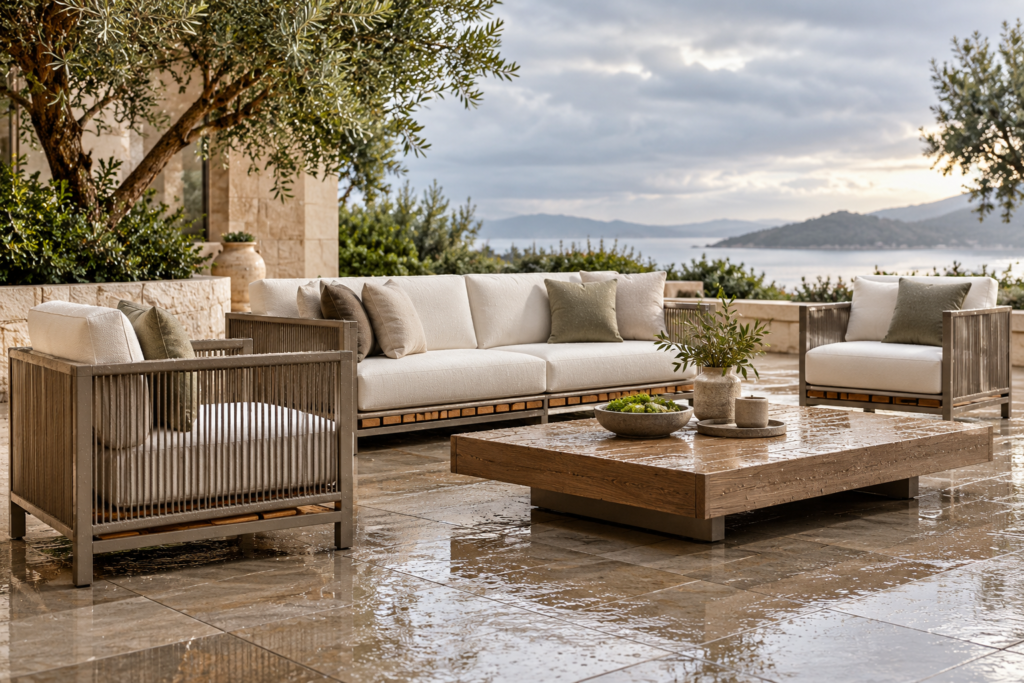
A beautifully upholstered outdoor sofa should not need perfect weather to perform beautifully. The real test often comes after the rain has stopped: when the terrace is reopening, guests are returning and the furniture needs to recover.
For outdoor seating, water resistance is only part of the story. What matters just as much is whether moisture can move through or away from the product, whether air can circulate around damp components and whether the furniture can return to usable condition without unnecessary delay.
That outcome is not created by a single fabric label. It begins with an experienced manufacturer who understands the entire construction—and designs for wet conditions from the first sketch.
Quick Answer: What Makes Outdoor Furniture Recover Well After Rain?
Good outdoor furniture drainage design treats the sofa as a complete system: outer fabric, cushion filling, underside, seat support, frame and ground clearance. These elements must work together so water does not remain trapped. The goal is practical moisture management and faster recovery under real conditions—not a promise that every product will be instantly dry.
1. Weather Resistance Is Not the Same as Recovery
Water-repellent upholstery can slow the penetration of rain, but water may still enter around seams, zippers and cushion edges, especially during sustained exposure. A surface that looks dry does not necessarily mean the cushion beneath it is dry.
Experienced outdoor furniture manufacturers therefore think beyond the first contact with water. They consider what happens next: where moisture collects, how it escapes, and how the construction encourages drying after the weather changes.
2. Drainage Begins Beneath the Cushion
The most important design choices may be invisible in a finished product photograph. A seat platform needs to support the user comfortably while avoiding unnecessary pockets where water can remain beneath the cushion.
Depending on the design, properly engineered slats, open supports or drainage channels can allow water to move away from the seat. The spacing, strength and cushion support still need to be balanced. More openings are not automatically better; the complete construction has to work.
This is a detail that should be resolved by the furniture designer and factory before production—not left for a hotel purchaser to discover or redesign later.
3. Cushion Construction Is a System, Not a Fabric Choice
An outdoor cushion combines multiple layers, and each has a job. The cover contributes appearance, touch and weather resistance. The core determines comfort and may influence how moisture moves. The underside and seams can affect drainage, ventilation and serviceability.
Some designs use porous, quick-draining cores and breathable lower panels. Others rely on carefully arranged barriers that direct water away from the filling. Neither approach works in isolation: the materials and details must suit the intended environment.
An experienced supplier should already understand the strengths and limitations of its chosen cushion system and be able to explain its overall design in clear language.
4. The Frame Should Not Become a Reservoir
Water management continues below the upholstery. Hollow members, joints and decorative recesses can retain moisture if the frame has not been designed appropriately.
For aluminum, timber or mixed-material frames, the engineering should address water entry, drainage and drying without compromising structural integrity or finish quality. Any drain provisions must be designed by the manufacturer rather than improvised after delivery.
Thoughtful construction is often quiet: there may be no visible feature to advertise, only a product that behaves more predictably after rain.
5. Airflow and Ground Clearance Matter
Even when water has a path out, recovery can be slowed if damp surfaces remain pressed together or furniture sits in standing water. Appropriate clearance beneath the seat, sensible cushion support and a terrace that drains properly all contribute to the result.
A sofa placed on a sheltered, well-drained deck may dry differently from the same sofa on a humid pool terrace. The manufacturer should understand the intended setting early enough to recommend suitable construction.
6. Design for the Climate, Not Just the Showroom
A coastal resort, an uncovered rooftop and a sheltered private patio do not experience moisture in the same way. Rainfall intensity, humidity, wind, temperature and daily operating patterns all influence how quickly furniture can return to use.
For a hotel, recovery time has a practical meaning. Staff may need to reopen an outdoor lounge after a shower. A damp seat can interrupt service even when the furniture still looks perfect.
This is why project experience matters. A supplier familiar with hospitality use can anticipate operational conditions while developing the product, rather than waiting for the buyer to ask a long list of technical questions.
7. Avoid the Myth of “Completely Waterproof” Outdoor Sofas
An outdoor sofa is not necessarily a sealed object, and sealing every layer can create its own moisture-management challenges. The right approach depends on the design.
Claims such as ‘waterproof’ or ‘dries in minutes’ should be understood in context. A cover that feels dry, a cushion core that has drained and a seat that is comfortable for guest use are not identical outcomes.
A reliable manufacturer should communicate performance realistically, including any limitations in prolonged rain or high humidity.
8. What Experienced Suppliers Do Differently
A capable outdoor furniture partner brings moisture management into product development from the beginning. Rather than waiting for a purchaser to specify every internal layer, the factory selects a suitable construction, identifies vulnerable details, develops a sample and checks how the assembled piece behaves.
The buyer’s role is to communicate the project: fully exposed or covered, coastal or inland, residential or commercial, occasional use or daily hotel operation. The manufacturer’s role is to translate those conditions into a coherent design and explain the reasoning behind it.
This partnership is more effective than treating procurement as a technical interrogation. Buyers should be able to trust the supplier’s experience while still receiving a clear explanation and appropriate evidence of performance.
9. A Well-Made Sample Makes the Design Tangible
A physical sample remains useful, but not because every buyer needs to become a furniture engineer. It allows the manufacturer and project team to confirm comfort, appearance, construction quality and moisture-management behavior together.
A practical wetting demonstration may reveal pooling or areas that stay damp longer than expected. Any drying-time comparison should account for environmental conditions and distinguish between surface dryness and the condition of the cushion interior.
The purpose is to refine and validate the design—not to imply that an informal demonstration is a certification.
10. Long-Term Performance Is About More Than the First Rain
Outdoor furniture is exposed repeatedly. Moisture management should therefore be compatible with structural support, cleaning access, material longevity and replaceable upholstery components where appropriate.
A product that recovers well after one shower but is difficult to maintain may not be the right choice for a busy hospitality project. Good engineering considers the entire service life.
What Should Hospitality Buyers Expect From a Supplier?
Buyers should not have to design the drainage system themselves. They should expect an experienced supplier to ask about the environment, recommend a suitable furniture construction, explain the general moisture-management strategy and be transparent about realistic performance.
The most valuable procurement question is often simple: ‘How was this furniture designed to recover after rain in our setting?’ A strong answer describes an integrated solution rather than naming only a fabric or foam.
Frequently Asked Questions
Does outdoor furniture need to be fully waterproof?
Not necessarily. Many successful designs manage water through drainage, ventilation and suitable materials rather than trying to seal every component.
Does quick-dry foam guarantee a dry sofa?
No. Cushion covers, seams, support platforms, airflow and surrounding conditions also influence recovery.
Why can an outdoor sofa remain damp after the surface looks dry?
Moisture may remain inside the cushion or beneath it. Surface appearance alone cannot confirm that the full seating system has dried.
Is a slatted seat always the best design?
No. Open supports are one possible solution. The right design depends on structural requirements, cushion construction and how water is directed away.
How can buyers choose a better outdoor furniture supplier?
Look for relevant project experience, a clear understanding of the installation environment, coherent sample construction and realistic explanations of how the complete product handles moisture.
Built for Life Outdoors
Premium outdoor furniture should feel as considered after a rainstorm as it does in a design rendering. Its resilience comes from decisions made long before the first guest takes a seat.
At CG Outdoor, custom outdoor furniture development can begin with the intended environment, desired design and operating requirements, so the frame, cushion and support structure are considered together. A beautiful silhouette matters—but so does what happens beneath it.
Good outdoor furniture is not simply designed to resist rain. It is designed to recover from it.