Two outdoor sofas can use almost identical frames and perform very differently in a hotel.
Often, the difference is hidden inside the cushions.
For residential furniture, a wet cushion is inconvenient.
For a resort with dozens of poolside sofas, cushions that remain saturated after rain can mean unavailable seating, additional housekeeping work and dissatisfied guests.
That is why professional buyers should not specify outdoor cushions simply as:
“waterproof cushions.”
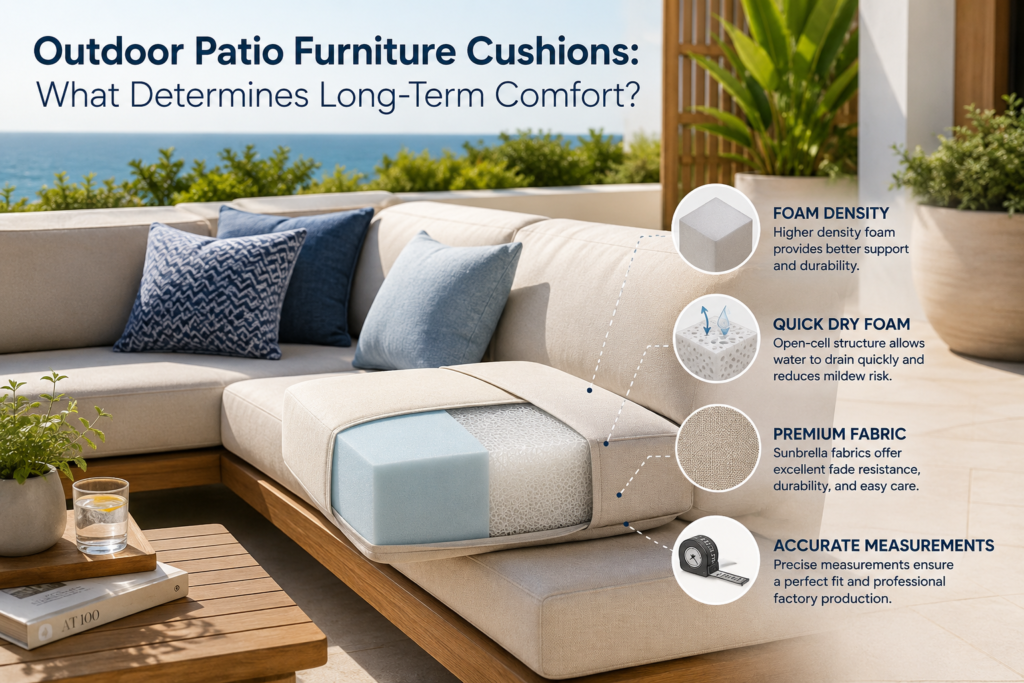
A cushion is a system.
Its performance depends on the relationship between fabric, foam, internal wrapping, seams, drainage and the furniture frame beneath it.
Water Resistant Is Not the Same as Waterproof
This is the first distinction buyers should understand.
Many outdoor fabrics are designed to resist water and dry quickly.
That does not necessarily mean a completed cushion is waterproof.
Water can enter through:
- Seams
- Zippers
- stitch holes
- fabric surfaces
- openings around piping.
Trying to make a completely sealed cushion can create another problem: moisture that enters may have difficulty escaping.
For many professional outdoor applications, the better objective is therefore not:
“No water can ever enter.”
It is:
“If water enters, how quickly and safely can it leave?”
Start With the Installation Environment
Before choosing the cushion construction, define where the furniture will be installed.
A covered hotel terrace has different exposure from a pool deck.
Useful categories include:
Covered Outdoor
Protected from direct rainfall but exposed to humidity and occasional wind-driven moisture.
Partially Exposed
Some protection from architecture, but regular rain exposure remains possible.
Fully Exposed
Furniture remains outdoors during rainfall and strong sunlight.
Poolside
Adds chlorinated water, wet swimwear and intensive guest turnover.
Coastal
Adds salt, humidity and often stronger wind exposure.
There is no reason to specify every cushion identically if the environments are different.
Foam Is About More Than Softness
Buyers frequently specify cushion foam primarily by density or firmness.
Those matter, but outdoor applications introduce another requirement:
water management.
Conventional foam can provide excellent comfort but may retain moisture depending on its structure and surrounding construction.
Reticulated or quick-dry foam has a more open cellular structure designed to allow water and air to move through the cushion more readily.
This can be especially useful in exposed hospitality applications.
But specifying quick-dry foam alone does not guarantee a quick-drying cushion.
The rest of the system must allow water to escape.
The Furniture Base Matters Too
Imagine placing excellent quick-dry foam on a completely solid seat platform with nowhere for water to drain.
The cushion may release water.
The furniture does not.
That is why outdoor cushion performance begins partly with the frame.
Slatted bases, mesh supports or appropriately designed drainage openings can help water move away rather than collect beneath the cushion.
For buyers developing custom furniture, cushion engineering and frame engineering should therefore be reviewed together.
Fabric Selection Should Match the Project
Outdoor upholstery must deal with more than rain.
Depending on location, it may face:
- UV exposure
- Humidity
- Chlorine
- Salt
- Sunscreen
- food and beverages
- frequent cleaning
- abrasion.
A luxury residential terrace and a high-turnover hotel pool deck may therefore justify different specifications.
When comparing fabrics, buyers should consider the manufacturer’s documented performance characteristics rather than selecting purely by color and texture.
Relevant information may include:
- UV resistance
- Colorfastness
- abrasion performance
- cleaning guidance
- mildew resistance
- water repellency.
A premium appearance still matters.
The objective is to combine tactile quality with appropriate performance.
Removable Covers Are Valuable in Hospitality
Outdoor furniture eventually requires cleaning.
In commercial environments, removable covers can significantly simplify maintenance.
A well-designed cover should be removable without requiring furniture disassembly and should allow the maintenance team to reinstall it correctly.
Zipper placement matters.
It should be discreet in use but accessible when servicing is required.
For larger projects, replacement covers can also be ordered separately.
That allows a property to refresh damaged cushions without replacing the complete cushion or furniture frame.
Consider Spare Fabric at the Beginning
This is one of the simplest procurement decisions that can save considerable trouble later.
Fabric collections change.
Colors are discontinued.
Dye lots can vary.
A hotel may discover four years after installation that six cushions need new covers, only to find that the original fabric is no longer available.
For significant projects, buyers can consider ordering:
- spare fabric
- replacement covers
- or a small quantity of complete replacement cushions
with the original production.
The appropriate quantity depends on project size and operating conditions.
Cushion Attachment Matters
- Outdoor cushions move.
- Guests move them.
- Wind moves them.
- Cleaning teams remove them.
- Seat cushions may gradually slide forward during use.
Possible solutions include:
- Velcro
- Straps
- hidden fasteners
- anti-slip materials
- furniture geometry that physically retains the cushion.
The best approach depends on the design.
Visible straps may work perfectly on one collection and undermine the clean appearance of another.
Attachment should therefore be considered during product development rather than improvised after installation.
Piping and Seams Change the Look
Soft furniture can look significantly different depending on sewing construction.
Piping creates a more defined edge.
Knife-edge cushions create a different visual language.
Top stitching can emphasize geometry.
Seam placement can either reinforce or interrupt the furniture’s proportions.
These details should be visible on drawings or approved samples.
“Same as photo” leaves too much room for interpretation.
Outdoor Cushions Need Realistic Maintenance Expectations
No outdoor textile system eliminates maintenance.
Even high-performance materials benefit from sensible operating practices.
Properties may need procedures for:
removing debris
cleaning spills promptly
allowing cushions to dry
storing cushions during severe weather
using furniture covers during extended closure periods.
Furniture specification and property operation should work together.
A cushion designed for exterior use is more resilient.
It is not indestructible.
Ask These Questions Before Ordering
For a hotel, resort or commercial project, the buyer should be able to answer:
Where will the furniture be installed?
Is it covered, partially exposed or fully exposed?
What foam construction is specified?
How will water drain from the cushion?
How will water drain from the furniture frame?
What performance fabric is being used?
Are the covers removable?
How are cushions attached?
Can replacement covers be reordered?
Should spare fabric be purchased with the project?
These questions turn “outdoor cushion” from a vague product description into a usable specification.
Comfort, Appearance and Performance Must Work Together
Commercial furniture sometimes overcorrects toward durability.
The result can be technically robust but visually institutional.
Luxury hospitality requires something more considered.
Cushions should retain generous proportions.
Fabrics should feel appropriate to the environment.
Edges and seams should look refined.
The furniture should still invite guests to sit down.
This is one reason high-end outdoor design increasingly borrows the scale and comfort language of indoor furniture while adapting its construction for exterior conditions. RH’s current outdoor positioning similarly combines residential-scale forms with teak or all-weather aluminum and outdoor cushion technologies, reflecting this broader premium-market direction. RH
The best specification does not ask buyers to choose between beauty and performance.
It engineers both.
Specify the Cushion as a System
When sourcing outdoor furniture, buyers naturally spend considerable time discussing frames.
Teak or aluminum?
Powder-coat color?
Rope pattern?
Profile dimensions?
The cushion deserves the same level of attention.
For hospitality furniture, its construction directly influences guest comfort, drying time, appearance and maintenance workload.
At CG Outdoor, cushion requirements can be developed together with furniture dimensions, frame construction and the intended installation environment.
Because an outdoor cushion is not simply something placed on top of the furniture.
It is part of the furniture’s performance system.