A dining chair may look elegant in a product photograph. But what happens when the restaurant closes? Does the team need to move 80 chairs for cleaning? Can the chairs be
stored before a seasonal closure? Will their finishes survive repeated handling? Do they need to be carried through a narrow service corridor?
For hospitality buyers, these questions can be as important as silhouette, upholstery and color. That is why choosing between stackable outdoor dining chairs and fixed-frame chairs should begin with how the venue operates—not only how the furniture looks.
Quick Answer: Which Type Is Better?
Stackable outdoor dining chairs are often better for venues that frequently rearrange seating, clear terraces or need compact storage.
Fixed-frame outdoor dining chairs can be a strong choice for stable layouts where sculptural form, generous proportions or complex upholstery matter more than compact storage.
Neither is automatically more durable or more premium. Quality depends on the design, construction, materials and intended use.
1. Think About the Daily Reset
A resort restaurant may arrange its chairs once in the morning and leave
them in place. An event terrace may change from breakfast seating to a reception and then to an evening dining layout. These are different operational environments. If staff must frequently move furniture, ease of handling becomes part of the product specification.
Ask how often the chairs will be moved, whether they must be stored, and who will handle them. A chair that is comfortable to sit in is not necessarily convenient to carry dozens of times each week.
2. Stackable Does Not Mean Every Chair Stacks the Same Way
Two chairs can both be described as “stackable” while behaving very
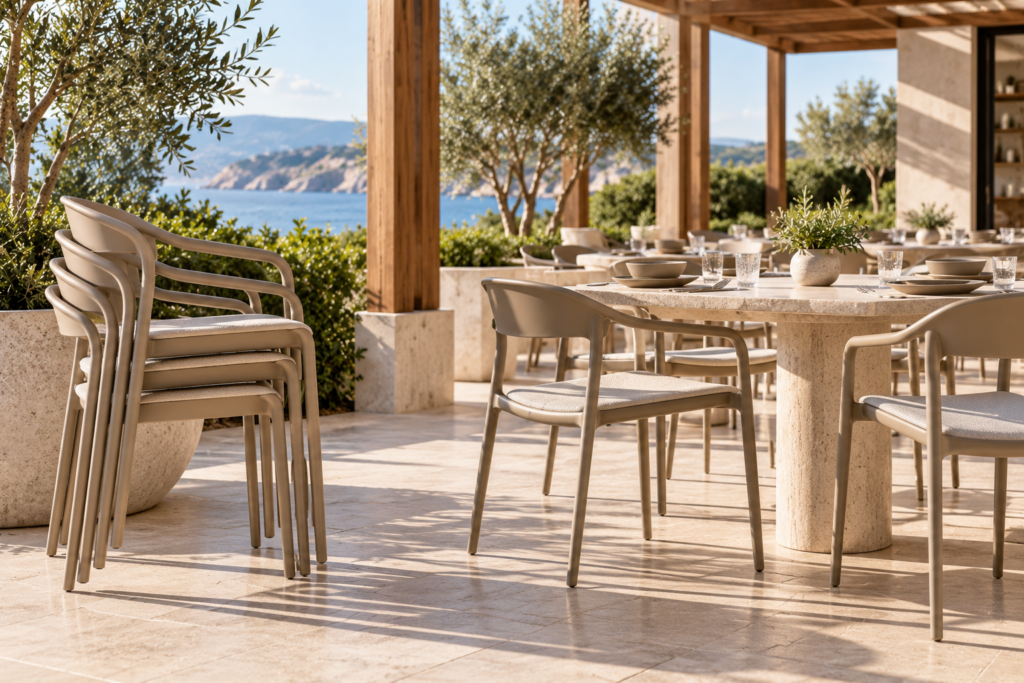
differently. One may nest neatly into a compact stack. Another may allow only a few chairs to be stacked before becoming awkward. The allowable stack count is product-specific. It should be confirmed by the manufacturer rather than assumed from a catalog photograph. Buyers should request a photograph or demonstration of the actual chairs stacked together, plus the approved maximum stacking quantity.
3. Consider the Weight of the Entire Stack
A lightweight chair can be convenient individually, but a tall stack may still be heavy and difficult to handle. The total load also depends on how the chairs are moved and whether an appropriate transport trolley is available. For commercial operations, safe handling rocedures and the manufacturer’s stacking instructions should determine how furniture is moved and stored. The correct goal is not the tallest possible stack. It is a manageable and stable storage system.
4. Protect the Finish During Stacking
Stacking creates repeated contact between furniture surfaces. Without thoughtful design, contact points may scratch powder coating, mark timber or abrade woven details. Ask where each chair touches the next one. Well-designed stackable chairs may incorporate protective spacers, glides or other features that help reduce finish-to-finish contact.
This detail can be easy to overlook during sample approval because a single chair reveals very little about stacking performance. Request a stacking trial with several chairs.
5. Fixed-Frame Chairs Allow Greater Design Freedom
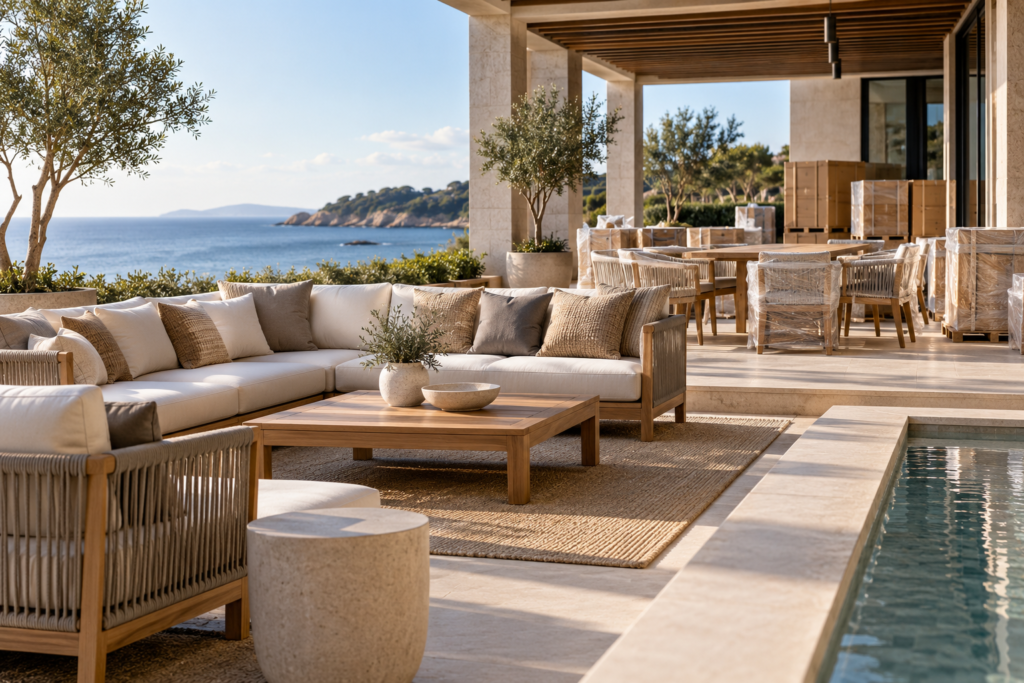
A fixed-frame chair does not need to fit inside another chair. That can allow more freedom in the shape of the arms, back and base. A generous rope-wrapped barrel chair, for example, may have an expressive silhouette that would be difficult to make stackable without changing its proportions. Fixed chairs can also accommodate substantial upholstery and more complex joinery.
For a luxury hotel dining terrace that rarely changes configuration, these qualities may be more important than compact storage. The trade-off is the space and effort required when the chairs need to be moved.
6. Do Not Sacrifice Comfort for Storage
Stackability should not determine every dimension. Dining comfort still depends on seat height, depth, back angle, arm position and compatibility with the table. A chair that stacks efficiently but feels uncomfortable after a long meal is not a successful hospitality specification.
The selected sample should be tested at the actual table height. For armchairs, check clearance beneath the tabletop and any apron. The operational benefit of stacking should not come at the expense of guest experience.
7. Storage Space Should Be Calculated Before Ordering
A chair that stacks is not automatically easy to store. Buyers should consider the available storeroom floor area, doorway width, ceiling height and movement route.
For a venue with 120 chairs, the difference between stacks of four and stacks of eight may significantly affect storage planning. But the manufacturer’s permitted stack height must always take priority over theoretical space savings.
If there is no suitable storage area, stackability alone may not solve the operational problem.
8. Match Materials to the Exposure
Outdoor chairs may be made from aluminum, teak, synthetic rope, wicker or engineered polymer. Each material brings different design and maintenance considerations. For example, a powder-coated aluminum frame may be practical for frequent handling, but contact points still need protection. A teak chair can offer warmth and visual substance, but a large solid-wood design may be less convenient to stack or move.
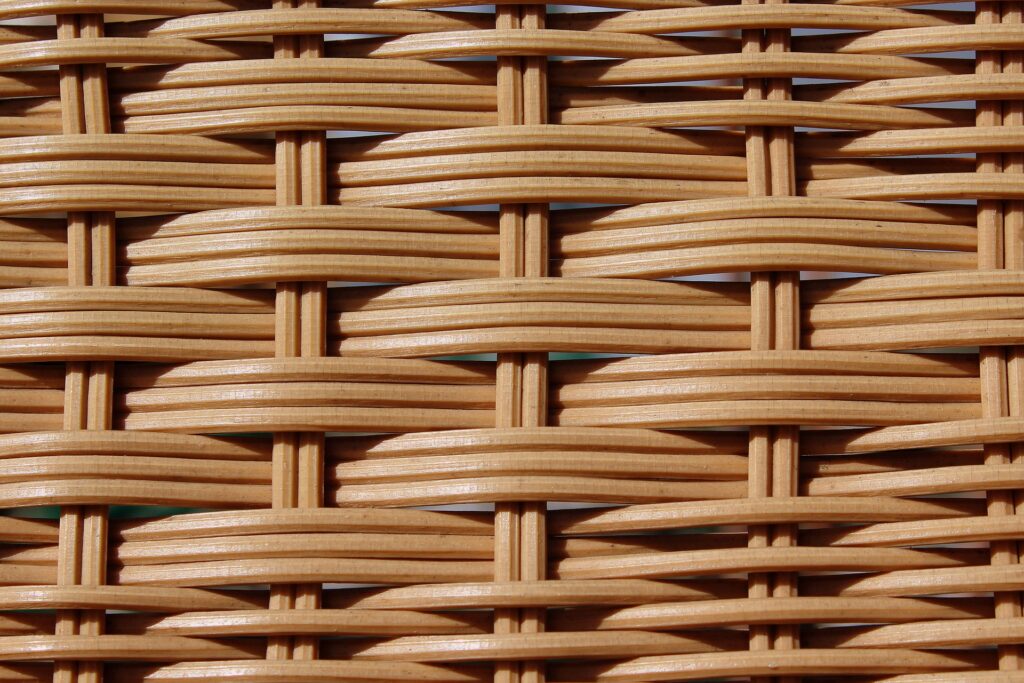
Rope and woven details can create a premium texture, yet the weaving must be designed to avoid abrasion where chairs touch. Material selection should reflect both the environment and the handling routine.
9. Ask for Evidence of Commercial Suitability
A claim such as “commercial grade” should be supported by appropriate product information. For European outdoor seating, the EN 581 series is relevant. EN581-1:2017 covers general safety requirements for outdoor seating and tables, while EN 581-2:2026 addresses structural safety and testing for outdoor seating used in camping, domestic and contract settings.
The current EN 581-2 edition does not assess every aspect of outdoor performance; its scope excludes, among other things, weather-related ageing and removable upholstery. Those characteristics need separate evaluation.
Buyers should confirm which standards and test reports apply to the exact model and destination market rather than assuming one certificate covers every requirement.
10. Consider Seasonal Closures and Weather Procedures
Hotels in seasonal destinations may store outdoor dining furniture for part of the year. Restaurants may also clear exposed terraces ahead of severe weather. A stacking system can simplify these operations, but it should be planned alongside suitable storage space and safe handling procedures. The choice of chair does not replace the property’s weather-response plan.
11. Test the Chair as a System
Before confirming a large order, evaluate more than the chair by itself. Review the chair with the actual table, in the intended dining layout, and—if stacking is required—in a realistic storage demonstration.
Check how the chair feels when seated, how it is lifted, how the legs and arms contact adjacent chairs, and whether the stacked configuration follows the manufacturer’s instructions.
A useful sample review includes both guest use and staff handling.
12. Use Different Chair Types Where the Project Needs Them
A hotel does not have to choose one chair construction for every dining area.
A flexible event terrace may benefit from stackable seating.
A signature restaurant may use fixed sculptural armchairs.
A pool café may prioritize compact, easy-to-move chairs.
The project can retain a coherent visual identity through related finishes, colors and materials even when the construction varies by zone. This is often more effective than forcing every space to use the same product.
Frequently Asked Questions
Are stackable outdoor dining chairs suitable for luxury hotels?
Yes. Stackability is a functional feature, not a price category. A well-designed stackable chair can be visually refined and suitable for premium hospitality settings.
How many outdoor chairs can be stacked?
There is no universal number. The safe maximum depends on the specific chair design and the manufacturer’s instructions.
Are fixed-frame chairs stronger than stackable chairs?
Not necessarily. Strength and durability depend on the engineering,materials and test results of the individual product.
What should a buyer request before placing a bulk order?
Request the complete dimensions, chair weight, approved stack count if applicable, material and finish specifications, relevant test information, and a physical sample or demonstration.
Which option is better for a restaurant that changes layout every day?
Stackable seating may reduce handling and storage demands, provided the selected model meets comfort, appearance and commercial performance requirements.
Specify for the Experience Behind the Scenes
Guests notice comfort, proportion and atmosphere. Staff notice weight, movement, storage and cleaning access. A successful hospitality chair must respect both experiences.
At CG Outdoor Furniture, custom project discussions can consider chair dimensions, frame construction, materials and intended operating conditions together, so the final selection suits the space rather than simply the product photograph.
The right outdoor dining chair should feel effortless at the table—and practical long after service ends.