For years, outdoor furniture was often treated as a separate category.
A table, a few chairs, perhaps a lounge chair beside the pool.
Today, the most successful outdoor spaces are being approached very differently.
Terraces, gardens, rooftops and pool decks are increasingly designed as rooms without walls—places for dining, conversation, relaxation and entertaining.
The furniture is no longer simply placed outdoors.
It becomes part of the architecture.
This shift changes the way outdoor furniture should be specified.
From Outdoor Furniture to Outdoor Living
Interior rooms are rarely designed around a single object.
A living room contains seating, tables, lighting, textiles and accessories that relate to one another.
An outdoor space increasingly requires the same thinking.
Instead of asking:
“What sofa should we put here?”
Designers and buyers are beginning with a broader question:
“How should people live in this space?”
The answer may involve several different zones.
A terrace might include:
- a lounge area
- dining space
- chaise lounges
- side tables
- a fire feature
- planters
- lighting
- shade structures
When all of these elements are considered together, the outdoor area begins to feel intentional rather than furnished.
Comfort Standards Are Moving Outdoors
Perhaps the most important change in outdoor furniture is comfort.
Traditional outdoor furniture was often designed around durability first.
Thin cushions, upright seating and relatively simple frames were accepted because the furniture had to survive outside.
That expectation has changed.
Today, buyers increasingly want outdoor sofas to feel closer to indoor upholstery.
Deeper seats.
More generous cushions.
Better back support.
Softer textures.
More relaxed proportions.
This creates a design challenge.
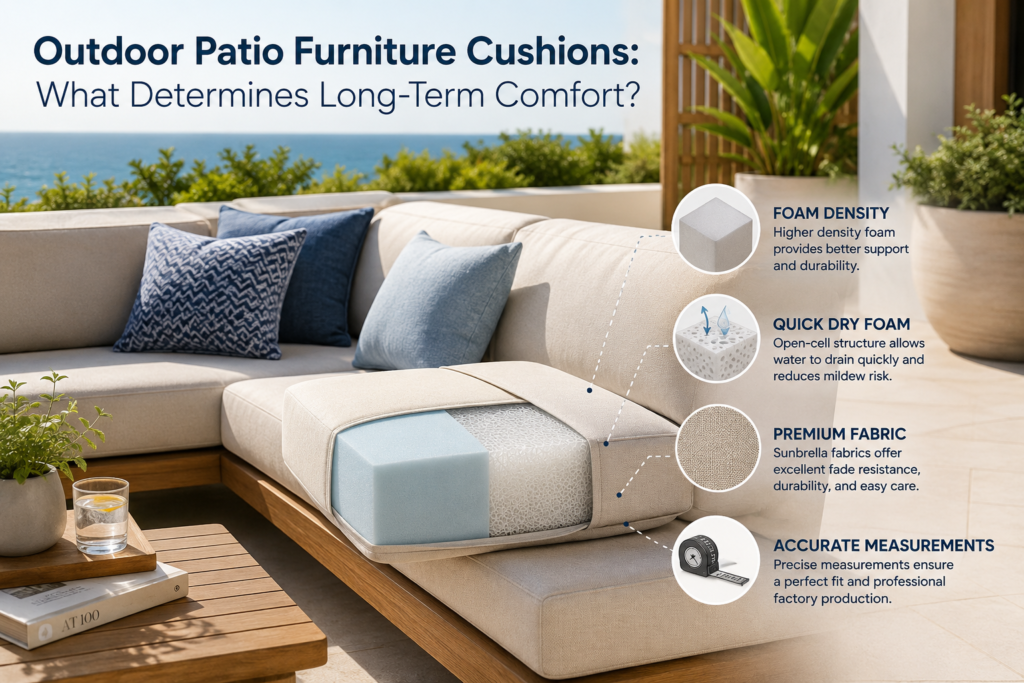
Outdoor furniture can look and feel increasingly residential, but the materials beneath that comfort still need to manage water, sunlight and changing weather.
A deep cushion may look luxurious, for example, but poor internal construction can allow it to remain wet long after rainfall.
The visual design and engineering therefore have to evolve together.
Outdoor Furniture Should Be Specified as a Collection
A common sourcing mistake is selecting outdoor products individually.
A sofa from one series.
A coffee table from another.
Dining chairs sourced separately.
A fire pit added later.
The products may all be attractive independently, yet still fail to create a coherent space.
A stronger approach is to think in collections.
This does not mean everything needs to match perfectly.
In fact, overly matched furniture can make a space feel more like a showroom than a home.
Instead, products should share a common visual language.
This may come from:
- material
- colour palette
- proportion
- timber tone
- metal finish
- fabric texture
- repeated design details
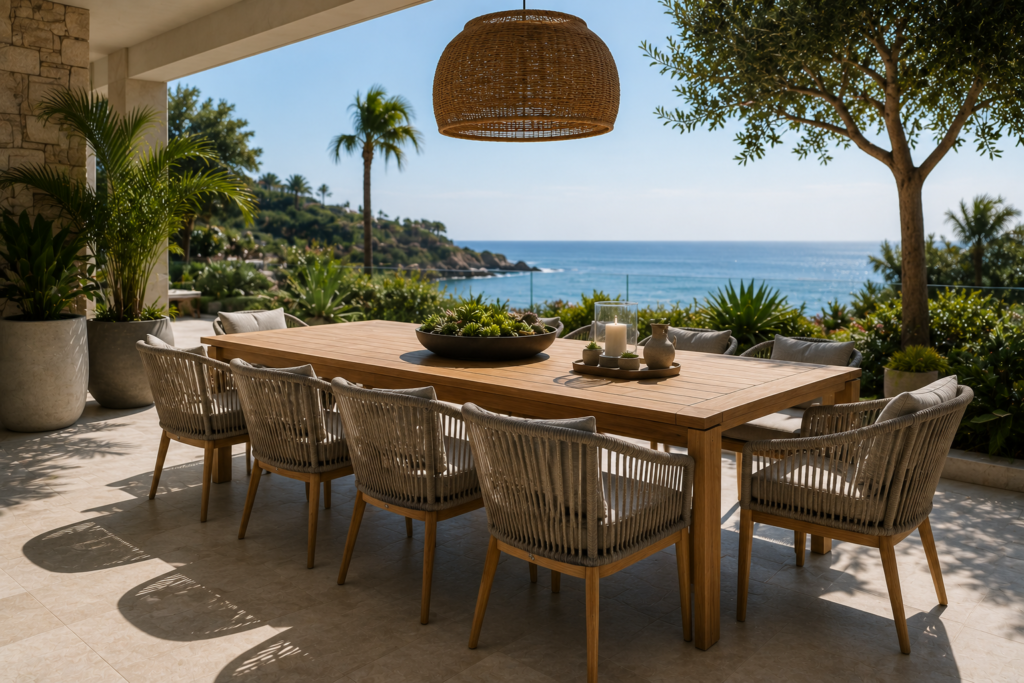
A teak dining table can sit comfortably beside an aluminum lounge collection when the proportions and colours are carefully coordinated.
Material variety often makes outdoor environments feel richer.
Consistency should come from design intention rather than identical products.
Scale Matters More Outdoors Than Many Buyers Expect
Large outdoor spaces can make ordinary furniture appear surprisingly small.
A sofa that feels substantial inside a showroom may look lost on a wide hotel terrace.
This is especially important for villas, resorts and hospitality projects where architecture tends to have larger proportions.
Furniture should be evaluated against:
- terrace dimensions
- ceiling or pergola height
- pool size
- surrounding architecture
- circulation paths
- landscape scale
Oversized furniture is not always the solution.
The goal is appropriate visual weight.
A large terrace may require a longer sectional rather than several small individual sofas.
A wide dining space may work better with a substantial table and fewer, better-scaled chairs.
Furniture dimensions should therefore be discussed during space planning rather than after the layout has already been finalized.
Think in Zones, Not Products
One of the easiest ways to design a large outdoor space is to divide it into functional zones.
Lounge Zone
The lounge zone should encourage conversation.
Seat orientation matters as much as seat design.
Sofas and lounge chairs should relate comfortably to one another rather than simply line the perimeter of the terrace.
Coffee tables should be positioned within natural reach.
Side tables provide practical surfaces without interrupting circulation.
Dining Zone
Outdoor dining should feel integrated into the overall environment.
Dining tables should provide enough room for chairs to move comfortably while maintaining circulation around the perimeter.
For hospitality projects, service access should also be considered.
Relaxation Zone
Chaise lounges, daybeds and recliners create quieter areas.
These are particularly effective near pools or in locations oriented toward views.
Spacing becomes important because guests often prefer a degree of privacy around relaxation furniture.
Fire Feature Zone
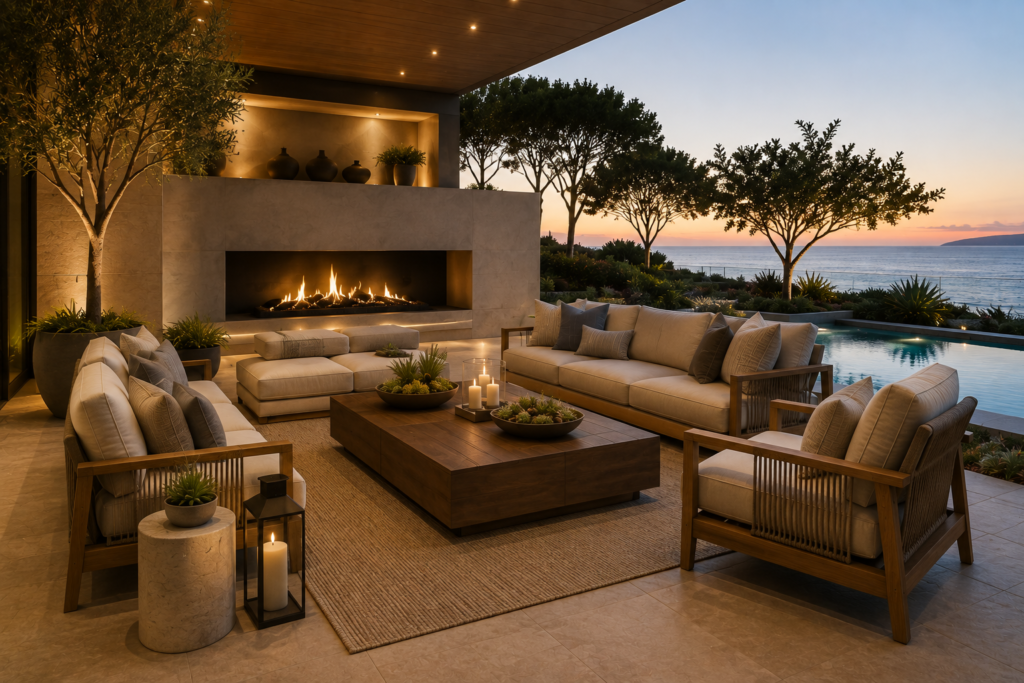
Outdoor fireplaces and fire pits increasingly function as gathering points.
Furniture layout should be planned around comfortable viewing and heat distance.
The fire feature should feel integrated into the setting rather than added after the furniture has been selected.
The Indoor-Outdoor Connection Should Feel Intentional
One of the strongest characteristics of contemporary outdoor design is visual continuity between interior and exterior spaces.
Large sliding doors and open architecture often place indoor and outdoor furniture within the same view.
A dramatic difference in style can make the transition feel disconnected.
This does not mean using indoor furniture outside.
Instead, consider continuity in:
- colour
- scale
- material tone
- design language
- upholstery palette
If the interior uses warm natural oak, an outdoor teak collection may create a natural relationship.
If the architecture is more minimal, powder-coated aluminum with restrained upholstery may feel more appropriate.
Outdoor furniture should complement the building rather than compete with it.
Textiles Are Becoming More Important
As outdoor furniture becomes softer and more residential, textiles play a larger role.
Fabric is no longer simply a protective covering for foam.
It contributes significantly to the character of the space.
Neutral upholstery can create a calm architectural foundation.
Accent cushions can introduce colour without dominating the setting.
Texture can make a monochromatic palette feel warm rather than empty.
Outdoor rugs can also help define zones within large terraces.
However, every textile decision still needs to respect outdoor conditions.
The most beautiful palette will not remain beautiful if the fabric is poorly suited to sunlight or moisture.
Fireplaces Are Becoming Part of Furniture Planning
Outdoor fire features were once often treated as landscape elements.
Increasingly, they are part of the furniture composition.
A rectangular fire table may replace a conventional coffee table.
A linear fireplace can define one side of an outdoor lounge.
A freestanding fire pit can create a separate conversation area.
This creates opportunities for more cohesive design, but dimensions become critical.
The relationship between flame position, seating height and user distance should be considered early.
Fire features should never be added simply because there is unused space.
They work best when they have a clear role within the outdoor room.
Hospitality Projects Need to Think Beyond Appearance
For hotels, resorts and restaurants, outdoor living design has another layer: operations.
Furniture may look beautiful but still create problems if it is difficult for staff to move, clean or maintain.
Commercial buyers should consider:
- furniture weight
- cushion removability
- replacement cushion availability
- cleaning requirements
- modular construction
- stackability where appropriate
- access for maintenance
- availability of replacement parts
Durability is not simply about whether a chair breaks.
It also includes whether the furniture remains practical to operate over many seasons.
Modular Furniture Gives Outdoor Spaces More Flexibility
Modular seating is particularly useful in contemporary outdoor environments.
Instead of building one large fixed sectional, separate modules can be combined to create different configurations.
This can be useful for hospitality spaces that occasionally change layouts for events.
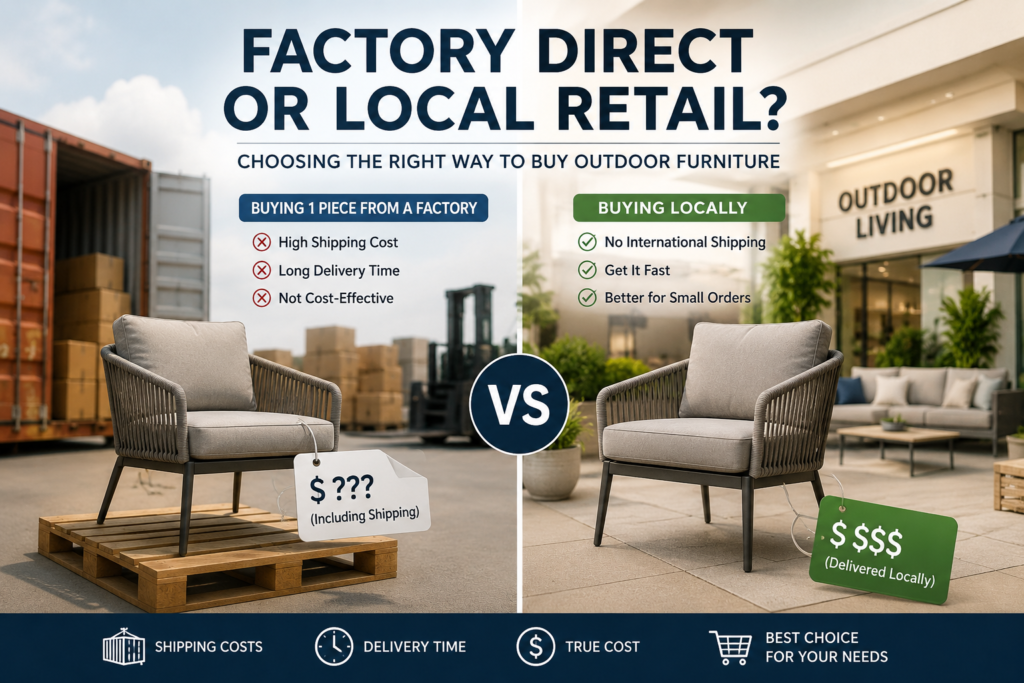
It can also simplify international shipping.
Individual modules are easier to manufacture, pack, transport and move on site than one oversized sofa.
For custom projects, however, module divisions should be carefully planned.
Poorly positioned joints can interrupt cushion comfort or make the sofa visually fragmented.
Good modular design should look intentional when assembled.
Custom Furniture Can Solve Architectural Problems
Standard furniture works well for many projects.
But unusual architecture often creates situations where standard dimensions leave awkward gaps.
Curved terraces.
Long narrow balconies.
Large pool decks.
Angled walls.
Built-in architectural elements.
These spaces may benefit from custom sizing.
Custom furniture should not be used simply to make everything different.
Its greatest value is solving a specific spatial problem.
Sometimes changing the length of a sectional by 20 cm dramatically improves circulation.
Sometimes a custom dining table allows the correct number of seats without overwhelming the space.
The best custom decisions often appear simple once installed because the furniture feels as though it was always meant to be there.
Outdoor Furniture Is Becoming Part of Architecture
The most interesting outdoor spaces no longer feel like patios with furniture placed on them.
The furniture participates in the architecture.
A sectional may reinforce the line of a building.
A long dining table may align with the landscape.
A daybed may frame a view.
A fire feature may define a gathering space.
When these relationships are considered carefully, furniture stops behaving like decoration.
It becomes part of how the space works.
What Buyers Should Specify Differently
As outdoor spaces evolve into complete living environments, furniture specifications should become more detailed.
Instead of specifying only:
“Outdoor sofa, beige fabric.”
Consider specifying:
- frame material
- frame finish
- seat depth
- seat height
- cushion construction
- outdoor foam type
- upholstery performance
- hardware grade
- module dimensions
- joining method
- furniture covers
- replacement cushion requirements
These details may appear technical, but they ultimately influence comfort, appearance and longevity.
A successful outdoor room is created by many small decisions working together.
Final Thought
Outdoor living is no longer a secondary extension of the home, hotel or restaurant.
For many projects, it is one of the most valuable spaces.
People dine there.
Relax there.
Entertain there.
Sometimes they spend more time outdoors than inside.
Furniture therefore deserves the same level of consideration we give to interior spaces—while still acknowledging that nature imposes very different demands.
The strongest outdoor environments combine these two ideas.
They deliver the refinement and comfort of an interior room, but they are designed intelligently enough to live outside.