
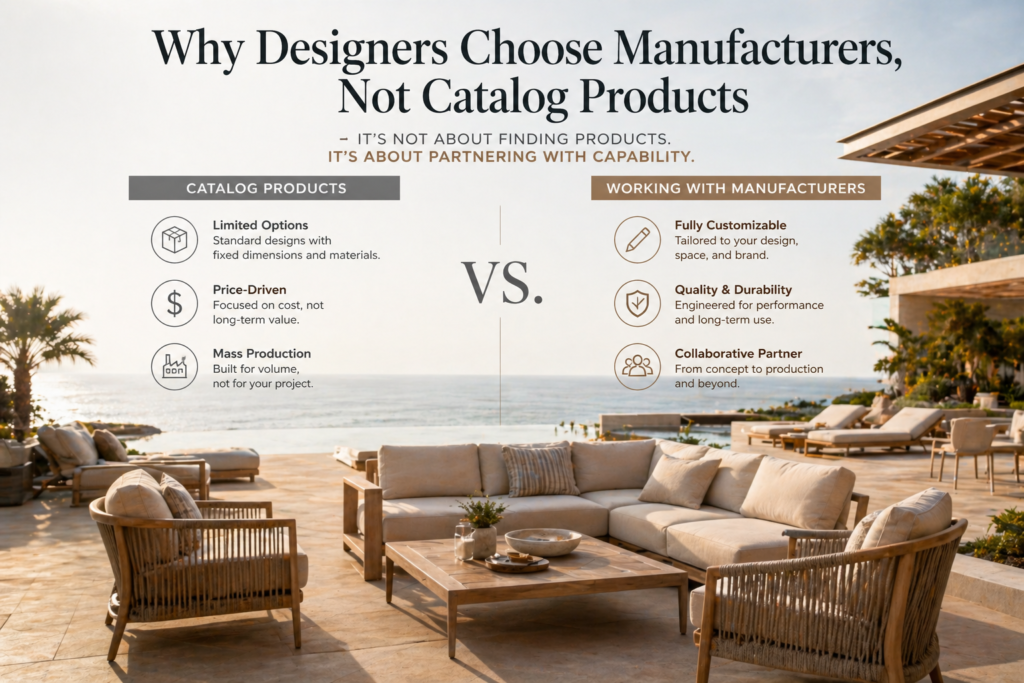
When sourcing patio furniture sets, the most common approach is to begin with what already exists.
Catalogs are reviewed. Collections are compared. Options are narrowed based on appearance, dimensions, and price.
This process feels efficient. It offers clarity. It presents furniture as a finished solution.
Yet for many projects, especially in hospitality or design-led environments, this approach reveals its limitations over time.
Because what is being selected is not only a product.
It is the result of someone else’s decisions—about proportion, material, structure, and cost.
And those decisions may not align with the needs of the project.
The difference between choosing a product and choosing a capability
At a certain level, sourcing shifts from finding a product to finding a partner.
A catalog presents a fixed outcome.
A manufacturer offers a range of possibilities.
This distinction is subtle, but fundamental.
When selecting from catalog-based patio furniture sets, the designer adapts to the product. Dimensions are adjusted. Materials are accepted as given. Compromises are made quietly.
When working with a capable manufacturer, the process reverses.
The product adapts to the design.
Proportions can be refined. Materials can be reconsidered. Details can be resolved more precisely. The furniture becomes part of the design process, rather than a constraint within it.
Not all manufacturers are built the same
It is important to recognize that manufacturing itself exists in different forms.
Some factories are structured around volume. They produce a single product at scale, optimized for cost and efficiency. Their systems are designed for repetition, not variation.
In these environments, production is highly controlled, but also highly fixed. Workers specialize in one task. Processes are streamlined for consistency. The result is efficiency—but also limitation.
These manufacturers are well suited for large retail distribution, where uniformity and cost control are primary objectives.
But this model does not translate easily to projects that require flexibility.
Flexibility is a form of craftsmanship
A different type of manufacturer operates with a different mindset.
Instead of producing one object repeatedly, the system is designed to adapt.
Materials change from project to project. Structures are adjusted. Details are refined. Workers are not limited to a single task, but move across different types of production.
This flexibility introduces a different kind of value.
It allows a sofa, a chair, a daybed, or a table to be approached not as a fixed product, but as a variation within a system. The result is not uniformity, but coherence.
Furniture produced in this way often carries a certain presence. It feels considered. It responds to its context.
This is where manufacturing begins to resemble craftsmanship—not in the sense of ornament, but in the ability to resolve details thoughtfully.
Catalog products often hide their limitations
Catalog furniture is designed to appeal broadly.
It must work across different environments, different climates, and different price expectations. To achieve this, decisions are made toward generality.
Materials are selected to meet average conditions. Dimensions are set to fit standard spaces. Details are simplified for scalability.
These choices are reasonable within their context. But when placed into a specific project, their limitations become visible.
The furniture may not align precisely with the architecture.
The material may feel out of place in the environment.
The proportions may not support the intended layout.
These are not defects. They are the result of designing for everyone.
Manufacturing collaboration changes the outcome
When designers work directly with manufacturers, the process becomes more collaborative.
Instead of selecting from predefined options, the conversation begins earlier.
What is the intent of the space?
What conditions will the furniture face?
What level of durability is required?
What visual language should be maintained?
These questions shape the product before it exists.
This approach is particularly relevant in hospitality projects, where furniture must balance design intent with long-term performance. The workflow behind this collaboration is outlined in
How to Work With CG Outdoor Furniture: From Inquiry to Delivery.
The role of expertise in long-term performance
A capable manufacturer does more than produce furniture. It interprets requirements.
It understands how structural decisions affect durability.
How materials behave in different climates.
How finishing influences long-term appearance.
This depth of understanding is often what determines whether a product performs well beyond installation.
It is also why experienced procurement teams evaluate suppliers not only by product, but by capability, as discussed in
What Makes a Reliable Outdoor Furniture Manufacturer in China.
Choosing patio furniture sets from a catalog is straightforward. It provides immediate answers.
Choosing a manufacturer requires a different perspective.
It asks the designer to consider not only what exists, but what can be created. It shifts the focus from selection to development.
In projects where identity, durability, and coherence matter, this shift often defines the outcome.
Because ultimately, sourcing is not about finding a product.
It is about finding the ability to make the right one.