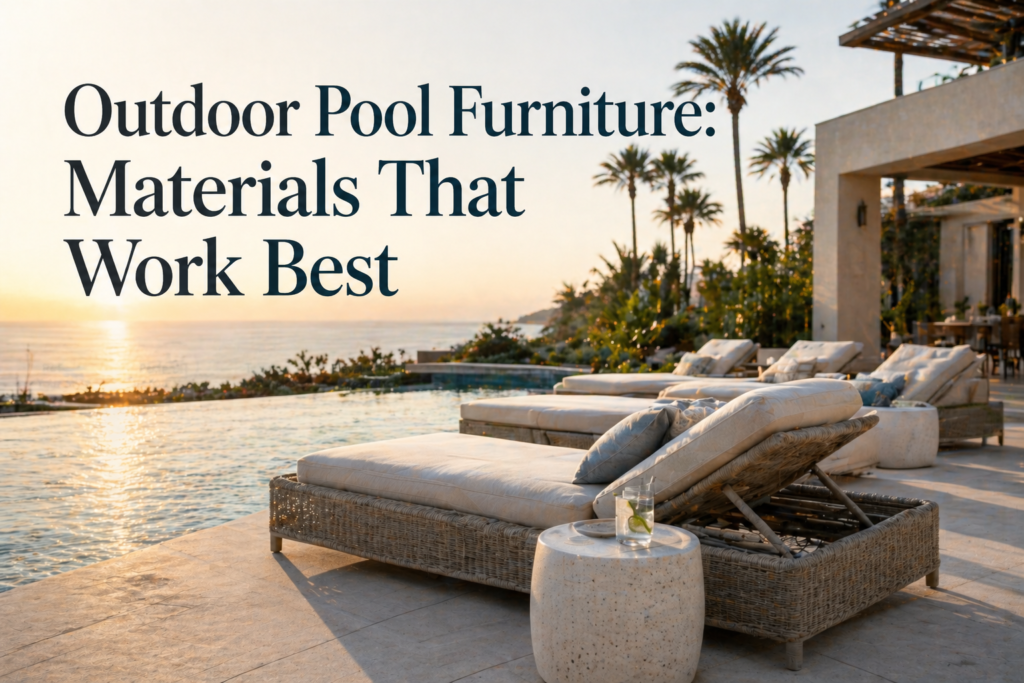
Poolside environments are among the most demanding conditions for outdoor furniture.
At a distance, these spaces appear calm—water, light, and open air. But from a material perspective, they are constantly under pressure. Chlorine lingers in the air. Sunlight is reflected and intensified by the water surface. Moisture is present not only after rain, but throughout the day.
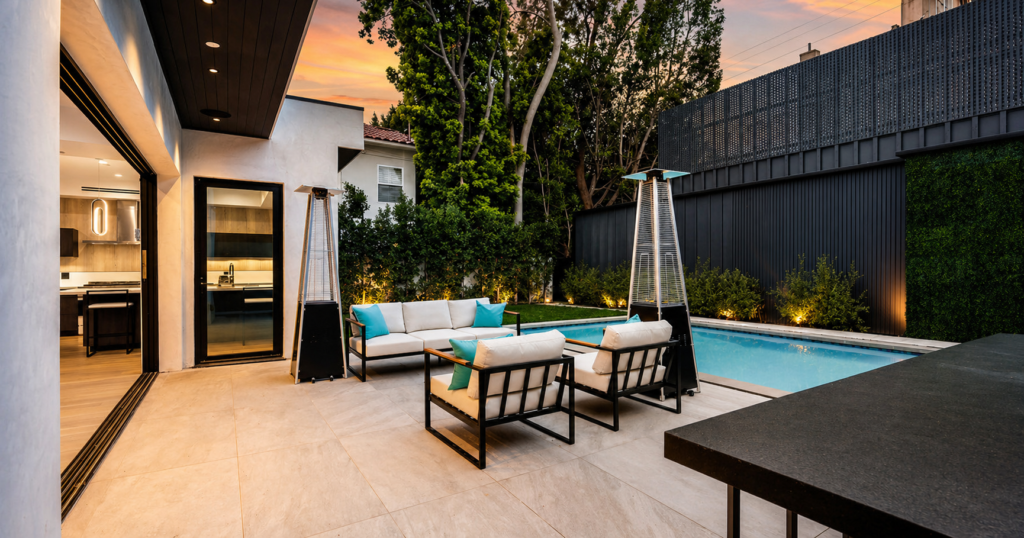
An outdoor pool furniture setting must endure all of this while remaining visually composed.
The challenge is not how the furniture looks when it is installed, but how it performs over time.
Chlorine quietly changes material behavior
Chlorine is rarely considered in design discussions, yet it plays a significant role in how materials age.
Unlike rainwater, which evaporates, chlorine leaves residues. These residues settle into surfaces, particularly in joints, woven structures, and fabric seams. Over time, they can alter material behavior—accelerating degradation in lower-quality components.
In poolside environments, this often becomes visible in subtle ways. Surfaces lose clarity. Materials become less flexible. Finishes begin to feel uneven.
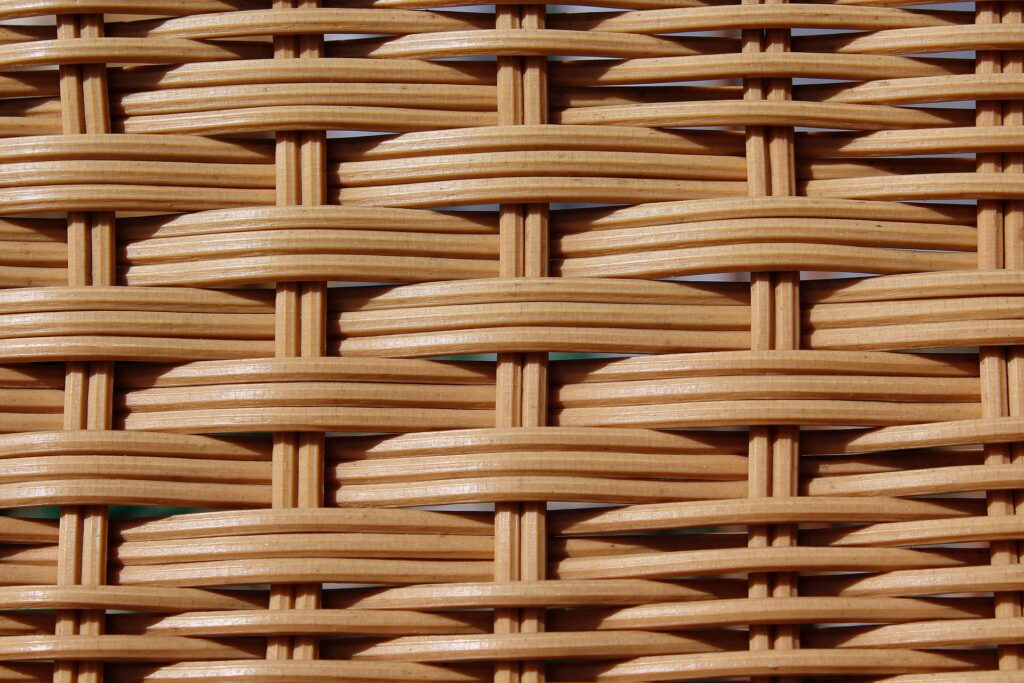
High-quality materials respond differently. They are selected with this exposure in mind. Synthetic materials such as well-engineered PE rattan maintain flexibility and consistency. Metal frames with proper finishing resist corrosion. Fabrics designed for outdoor use remain stable even with repeated contact.
The difference is not immediate. It becomes visible through time.
UV exposure is amplified near water
Sunlight alone is demanding. Near a pool, its effect is intensified.
Light reflects off the water surface, increasing exposure to UV radiation from multiple directions. Materials are not only exposed from above, but also from below and around.
This is why outdoor pool furniture often shows signs of aging earlier than furniture placed in shaded terraces or gardens.
Lower-grade materials may begin to:
- fade unevenly
- become brittle
- lose structural consistency
Higher-quality materials are designed to resist this process. UV stabilization is not an added feature—it is a requirement.
This principle is closely related to broader material selection strategies discussed in
Most Durable Outdoor Furniture Materials for Commercial Use.
Slip resistance shapes the user experience
Beyond durability, poolside furniture must also respond to movement.
Guests move between water and seating areas, often with wet feet and surfaces. In this context, slip resistance becomes part of the experience.
A well-considered outdoor lounge or daybed does not feel unstable when approached. Surfaces provide enough friction without feeling rough. Materials remain predictable even when exposed to water.
This is rarely addressed through design alone. It is the result of material selection and surface treatment.
What long-term performance actually looks like
Material performance is best understood not through specifications, but through use.
Several of our clients began using PE rattan poolside loungers and sofas in 2020. These pieces have remained in outdoor environments continuously—exposed to sun, rain, and pool conditions.
Over time, a pattern emerged.
- The frames have remained stable.
- The woven structure has retained its form.
- The foam continues to provide support.
After approximately three years, only one component required replacement: the cushion covers.
This year marks their second replacement cycle.
This detail is important.
It shows that in a well-constructed outdoor pool furniture system, the elements that are expected to age—such as fabric—can be replaced. The structural components remain intact.
Durability, in this sense, is not about preventing all change. It is about ensuring that what changes can be managed.
Materials are not chosen for appearance alone
In poolside environments, material selection defines not only aesthetics, but longevity.
Furniture that appears identical at installation can perform very differently after several seasons. The difference is rarely dramatic at first. It reveals itself gradually.
This is why experienced designers and procurement teams often evaluate materials based on how they behave under specific conditions, rather than how they appear in isolation.
An outdoor pool furniture setting is one of the most demanding applications in outdoor design.
Chlorine, UV exposure, and constant moisture create an environment where material quality is continuously tested.
When materials are properly selected and executed, furniture does not resist the environment—it adapts to it. It maintains its structure, preserves its visual clarity, and allows maintenance to be predictable.
Over time, this is what defines quality.