
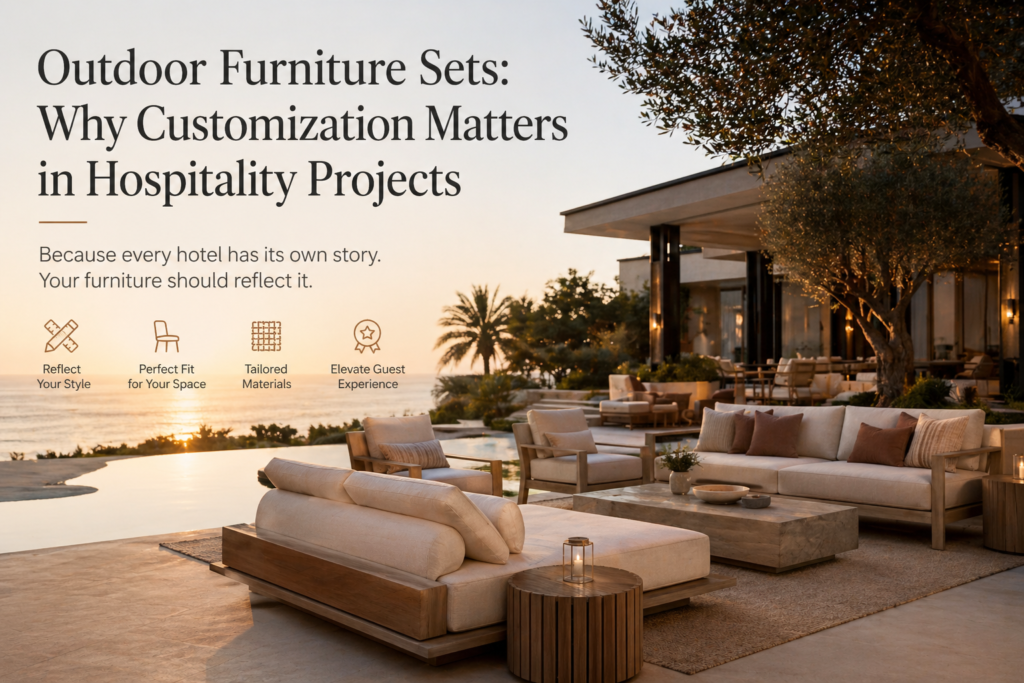
Outdoor Furniture Sets: Why Customization Matters in Hospitality Projects
An outdoor furniture set is often one of the first elements defined in a hospitality project.
At a surface level, the requirement seems straightforward—tables, chairs, sofas, and loungers arranged to support the intended use of the space. Yet in practice, these pieces carry a much deeper responsibility.
They do not simply furnish an outdoor area.
They shape how a guest experiences a place.
And increasingly, they define whether that place feels distinct—or forgettable.
Hospitality spaces are no longer interchangeable
There was a time when outdoor furniture in hotels followed a predictable formula. Neutral palettes, standard layouts, and widely available collections were sufficient.
Today, the expectation is different.
Guests move between cities, resorts, and brands with ease. They recognize repetition. They notice when spaces feel interchangeable. In this context, visual identity becomes essential.
A hospitality project is no longer judged only by comfort or function. It is remembered by how clearly it expresses its own character.
Outdoor spaces play a central role in this. They are open, visible, and often photographed. They become part of the brand’s visual language.
Standard furniture, by its nature, is not designed for this purpose. It is designed for general use, across unknown environments, without a specific identity in mind.
Customization begins where this limitation becomes visible.
Design intent requires more than standard solutions
In most projects, designers begin with a clear intent.
A certain proportion, a certain tone, a certain balance between materials. Sometimes it is subtle. Sometimes it is expressive. But it is always deliberate.
The challenge is that standard outdoor furniture sets rarely align perfectly with that intent.
The scale may be slightly off.
The material may feel too generic.
The detailing may not match the architectural language.
Individually, these differences may seem small. Together, they dilute the overall composition.
Customization allows the furniture to respond directly to the design, rather than forcing the design to adapt to the furniture.
Dimensions can be adjusted to fit the space precisely.
Materials can be selected to match the surrounding architecture.
Proportions can be refined to create visual balance.
This is not about making something entirely new. It is about resolving what standard products cannot.
The process of translating design intent into manufacturable solutions is described in
How Custom Outdoor Furniture Works for Hotel & FF&E Projects.
High-end hospitality depends on differentiation
The higher the positioning of a hotel, the more important differentiation becomes.
Luxury hospitality does not compete on availability. It competes on identity.
Guests expect not only comfort, but a sense of place. A feeling that the environment has been considered, rather than assembled.
Outdoor furniture plays a significant role in this perception. It is experienced up close, interacted with directly, and often repeated throughout the space.
When the furniture feels generic, the space feels generic.
When the furniture is resolved—when proportions, materials, and details align with the overall concept—the space gains clarity.
This is why high-end projects rarely rely entirely on standard furniture collections.
They require a level of control that only customization can provide.
Customization is not complexity, but alignment
There is a misconception that customization introduces unnecessary complexity.
In reality, it often reduces it.
Instead of adapting the layout to fit available products, the furniture is adjusted to fit the space. Instead of compromising on material choices, they are defined intentionally from the beginning.
This alignment simplifies decision-making later in the project.
It also reduces the risk of inconsistencies—between drawings and execution, between design intent and final installation.
From a procurement perspective, customization is less about variation, and more about precision.
The role of manufacturing capability
Customization is only meaningful when it can be executed correctly.
A design can specify dimensions, materials, and details, but these must be translated into a stable, repeatable product.
This is where manufacturing capability becomes critical.
A capable manufacturer understands not only how to produce a piece, but how to adapt it:
- adjusting structure without compromising strength
- selecting materials appropriate for the environment
- maintaining consistency across production
This level of execution is what allows a customized outdoor furniture set to perform reliably over time.
The criteria for evaluating such manufacturers are discussed in
What Makes a Reliable Outdoor Furniture Manufacturer in China.
An outdoor furniture set may appear to be a collection of objects, but in hospitality projects, it functions as part of a larger narrative.
Customization allows that narrative to remain coherent.
It ensures that furniture does not feel imposed on a space, but integrated into it. It allows designers to maintain control over proportion, material, and tone. And it gives projects the ability to stand apart in an increasingly uniform landscape.
In that sense, customization is not an enhancement.
It is often the condition required for a space to feel complete.