
Modern outdoor furniture is often discussed visually.
People speak about silhouettes, proportions, color palettes, and architectural harmony. The conversation usually begins with aesthetics.
But outdoor furniture does not live inside a controlled environment.
It exists in sunlight, humidity, wind, rain, salt air, and changing temperatures.
And because of this, truly successful modern outdoor furniture is not defined only by how it looks.
It is defined by how intelligently it responds to where it lives.
The environment shapes everything.
A furniture collection that performs beautifully in a dry climate may deteriorate rapidly beside the ocean. A fabric that remains stable in Europe may behave differently in tropical humidity. Even the same aluminum frame can age differently depending on airflow, salt exposure, and maintenance conditions.
This is why outdoor furniture should never begin with style alone.
It should begin with context.
Minimal design leaves no room for material failure
Modern furniture often appears effortless.
Clean lines. Slim structures. Light visual presence.
Yet achieving this simplicity requires significant precision.
Traditional furniture styles can sometimes hide imperfections through ornament or visual complexity. Modern furniture cannot.
If a frame deforms slightly, the line is broken immediately.
If a fabric fades unevenly, the imbalance becomes obvious.
Modern design depends heavily on material stability because every detail remains visible.
This is why material engineering is inseparable from modern aesthetics.
Climate changes the meaning of durability
Durability is often discussed as though it were universal.
But durability changes depending on environment.
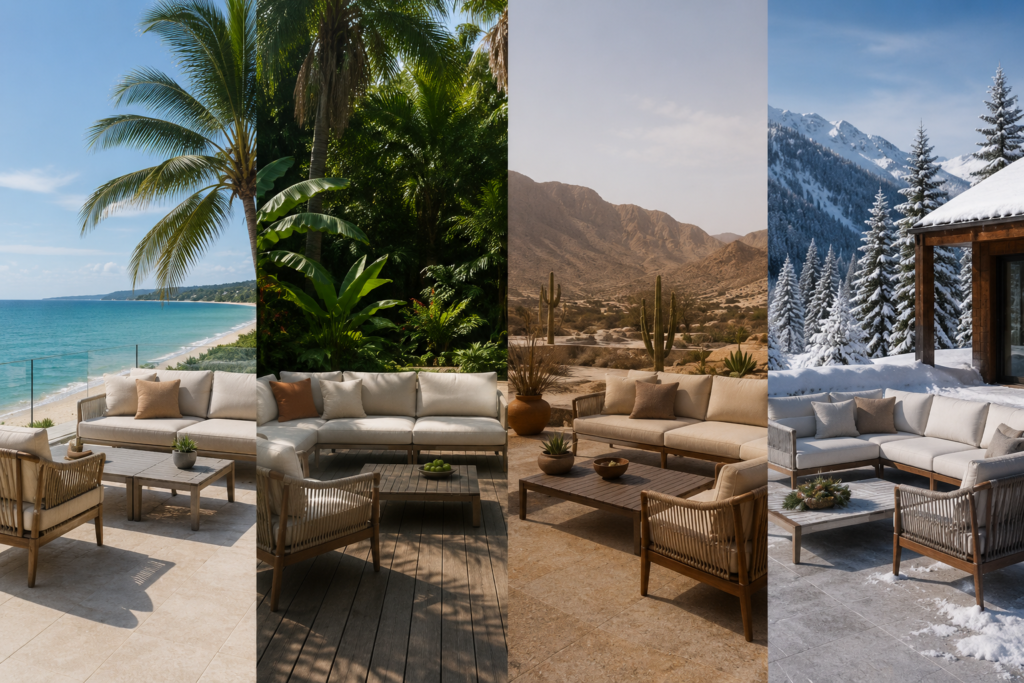
In hot tropical regions, UV exposure becomes the primary challenge. In humid coastal areas, corrosion dominates material behavior. In colder climates, freeze-thaw cycles introduce structural stress.
The same product cannot respond equally to all conditions without adaptation.
This is why experienced manufacturers often adjust:
- material specifications
- coating systems
- fabric selections
- structural reinforcement
based on project location.
This process is not about customization for appearance. It is about ensuring long-term environmental compatibility.
Outdoor furniture should age gracefully, not simply survive
One of the deeper differences between low-end and high-end outdoor furniture lies in how materials age.
Cheap materials often resist the environment temporarily before deteriorating suddenly.
Better materials age gradually and coherently.
Wood develops character rather than cracking unpredictably. Fabrics soften slightly while maintaining structure. Metal surfaces retain clarity instead of breaking down unevenly.
This distinction matters because outdoor furniture is experienced continuously.
Guests notice not only the furniture itself, but how it changes over time.
And often, that slow aging process defines whether a space continues to feel refined years after installation.
Design should follow environmental reality
A modern outdoor project succeeds when design ambition and environmental logic work together.
The goal is not simply to create beautiful furniture.
The goal is to create furniture that remains visually calm and structurally composed despite constant environmental pressure.
This is where material understanding becomes more valuable than trend awareness.
Because trends change.But the environment remains.