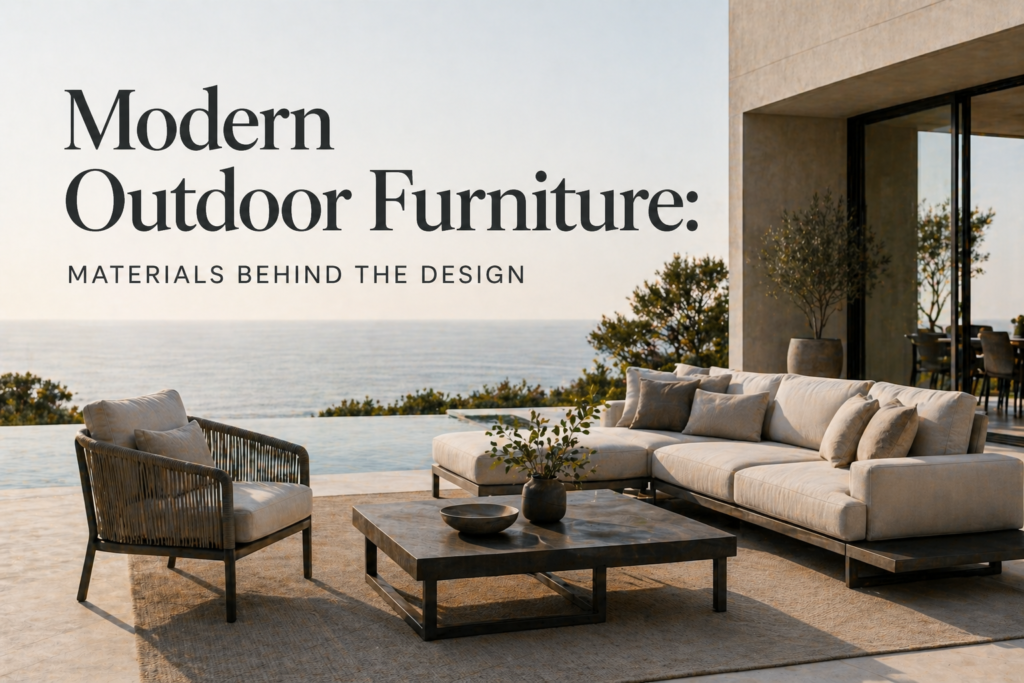
Modern outdoor furniture is often recognized immediately.
Clean lines. Controlled proportions. A sense of openness, where nothing feels excessive and nothing is hidden behind ornament.
At a glance, it appears to be a stylistic choice—minimal, restrained, contemporary.
But when looked at more closely, something else becomes clear.
The visual language of modern outdoor furniture is not only designed.
It is constructed through material decisions.
Remove the right materials, and the design collapses.
Choose them carefully, and the design begins to feel inevitable.
Simplicity is supported by precision
Modern design often appears simple, but it is rarely easy to achieve.
A traditional piece can rely on thickness, carving, or visual weight to create presence. A modern piece does not have that luxury. Every line is exposed. Every connection is visible. Every proportion is felt.
This is where material selection becomes critical.
A thin frame only works if it is structurally sound.
A light visual profile only works if the material can carry that load without distortion.
This is why aluminum has become central to modern outdoor furniture.
Not because it is lightweight in a general sense, but because it allows structure to be reduced without losing strength. It supports long spans, slim profiles, and precise geometry.
In this context, material is not supporting the design.
It is enabling it.
The role of texture in a restrained language
If structure defines the form, texture defines the experience.
Modern outdoor furniture rarely relies on heavy visual decoration. Instead, it introduces variation through subtle material contrasts.
Smooth metal surfaces.
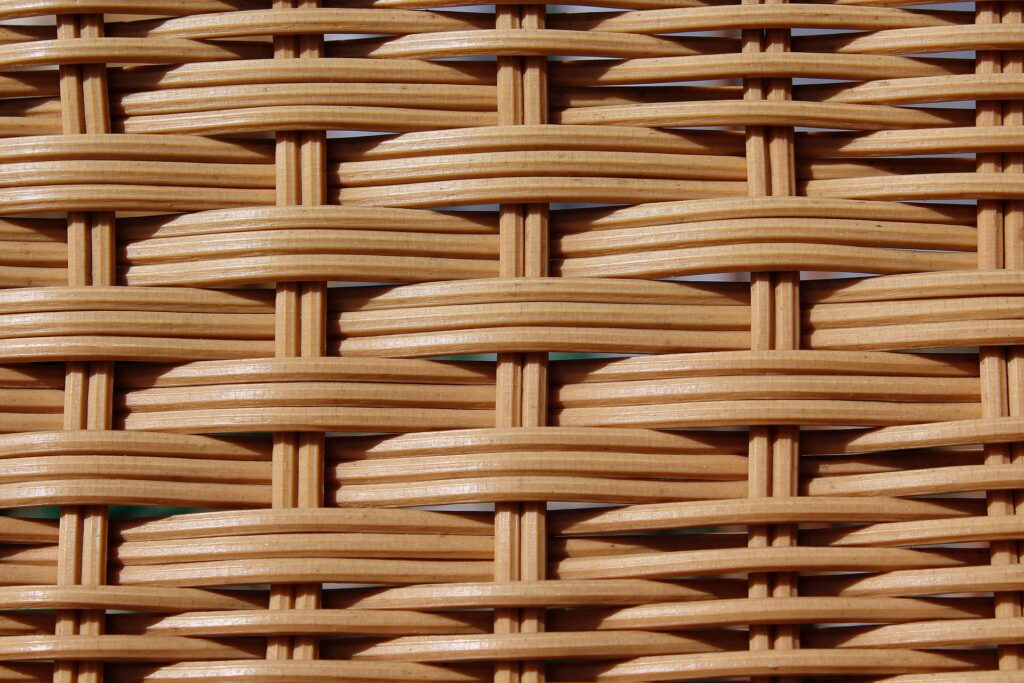
Soft woven elements.
Controlled fabric textures.
These layers create depth without overwhelming the overall composition.
Synthetic materials such as PE rattan or rope are often used in this way—not to imitate traditional forms, but to introduce a tactile quality that balances the precision of the frame.
The success of this balance depends on control.
Too much texture, and the piece feels decorative.
Too little, and it becomes sterile.
Modern design exists somewhere between these two conditions.
Outdoor materials must perform, not just appear
One of the challenges in modern outdoor furniture is that its visual clarity leaves no room for material failure.
In more decorative styles, wear can sometimes blend into the overall composition. In modern design, any inconsistency becomes immediately visible.
A slight deformation in a frame disrupts the entire line.
Uneven fading becomes noticeable across clean surfaces.
Material fatigue is no longer hidden—it defines the piece.
This is why material performance is not separate from design. It is part of it.
High-quality modern outdoor furniture relies on materials that can maintain:
- structural stability under long-term use
- color consistency under UV exposure
- surface integrity under moisture and temperature change
These principles are closely aligned with the broader material strategies discussed in
Most Durable Outdoor Furniture Materials for Commercial Use.
Fabric becomes part of the architecture
In modern outdoor furniture, cushions are not simply added for comfort.
They are integrated into the overall composition.
The thickness, alignment, and proportion of cushions influence how the entire piece is perceived. A cushion that is too soft loses definition. One that is too rigid breaks the sense of comfort.
Fabric, in this context, is not decoration. It is structure at a softer scale.
High-performance outdoor fabrics must balance several roles:
- They must maintain color under strong sunlight.
- They must resist moisture without feeling synthetic.
- They must hold shape while allowing comfort.
When these elements are aligned, the furniture feels composed—even after extended use.
Modern design requires manufacturing discipline
Because modern outdoor furniture reduces visual complexity, it increases the importance of execution.
There is less room for tolerance.
Connections must align precisely.
Finishes must be consistent.
Materials must behave predictably.
Small inconsistencies that might go unnoticed in other styles become immediately visible here.
This is why manufacturing capability plays a critical role.
A design may appear minimal on paper, but its success depends on how accurately it can be produced.
In custom projects, this often requires close coordination between design intent and manufacturing execution, as described in
How Custom Outdoor Furniture Works for Hotel & FF&E Projects.
What makes modern outdoor furniture feel “right”
There is a moment, when encountering a well-made modern piece, where it simply feels resolved.
Nothing draws attention unnecessarily.
Nothing feels out of place.
The proportions, materials, and textures align quietly.
This sense of resolution is not the result of style alone.
It is the result of decisions—about structure, material, and execution—working together without conflict.
Modern outdoor furniture is often described through its appearance.
In reality, its defining qualities are built into its materials.
- The clarity of the design depends on structural precision.
- The comfort depends on material balance.
- The longevity depends on performance under real conditions.
When these elements are aligned, modern outdoor furniture does not feel minimal.
It feels complete.
And it is within that completeness that its design begins to hold its value over time.